“. . . multiple viewpoints into her legacies . . .”
Embedded with cultural knowledge, Gracie Greene’s (1949–2025) oeuvre connects with the everyday and the storytelling of traditional narratives. Born in Billaluna Station in 1949, after Greene’s parents came from the desert in the 1930/40s from Kartamarnti Country, she attended school at the Balgo mission and was a central figure in the establishment of Warlayirti Artists in Balgo in 1987. Gracie Greene – It’s Time, presented with The Berndt Museum and The Cruthers Collection of Women’s Art at Lawrence Wilson Art Gallery (with support from Mangkaja Arts as part of Perth Festival 2026), finally brings to light an iconic artist.
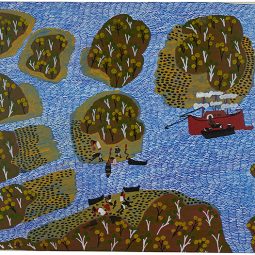
![[untitled], 1986](https://www.art-almanac.com.au/wp-content/uploads/2026/01/lawrence_wilson_preview_0226_untitled.jpg)
[untitled], 1986, acrylic paint on canvas board, 70.5 × 50cm
Berndt Museum, The University of Western Australia [1987/0015]Courtesy the estate of the artist and Mankaja Arts, Western Australia
Allowing for multiple viewpoints into her legacies as an artist, a cultural leader, and a champion in a time of experimentation and radical change, Gracie Greene – It’s Time showcases her unique contribution and idiosyncratic approach. One that merges traditional iconography with Western art – figuration, dot-work overlays, and colourful visual styles. Kinsella shares that an enticing curiosity of mixed painting modalities is offered, entirely consistent with her ethos of sharing cultural knowledge for cross-cultural understanding. “It’s her natural inclination as a communicator of culture to allow different points of entry for anyone to come into her paintings,” Kinsella says.
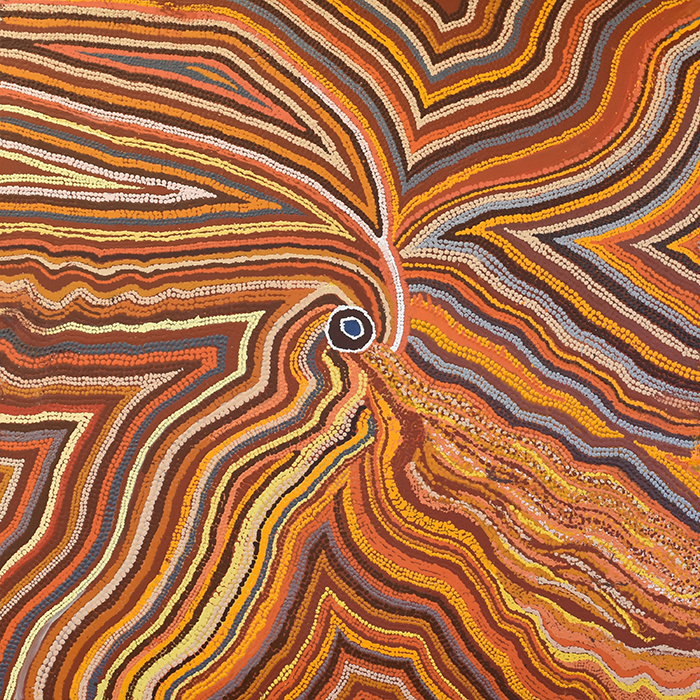
Ninmi Waterhole, my Ogee Country, 2018, acrylic paint on canvas, 120 × 90cm
Courtesy the estate of the artist and Mankaja Arts, Western Australia
In Greene’s acrylic painting on a canvas board, [untitled], 1986, she depicts the kingfisher’s creation dreamtime, as he plunges his beak into the ground when people lived underground in darkness, represented by the two women with firesticks. Alongside the figurative representation of the cultural narrative, Greene adds to the composition with swirling dot work, creating a sense of the ‘in between’ that carries these anecdotes through generations.
In recognition of her legacies, one of her last paintings hangs in the Fitzroy Crossing Health Centre, where she was receiving dialysis treatment. Employing the same style of her storytelling, Greene painted herself sitting in the chair, her footprints over to the dialysis machine, the blood flowing through the dialysis machine, and then, where the nurse’s footprints go between the medical equipment and tending to Greene on the dialysis machine. A poignant comment on her final days interwoven through cultural painting techniques, while also leaving a first-person perspective on the reality of how First Nations communities navigate life and health in remote Australia.
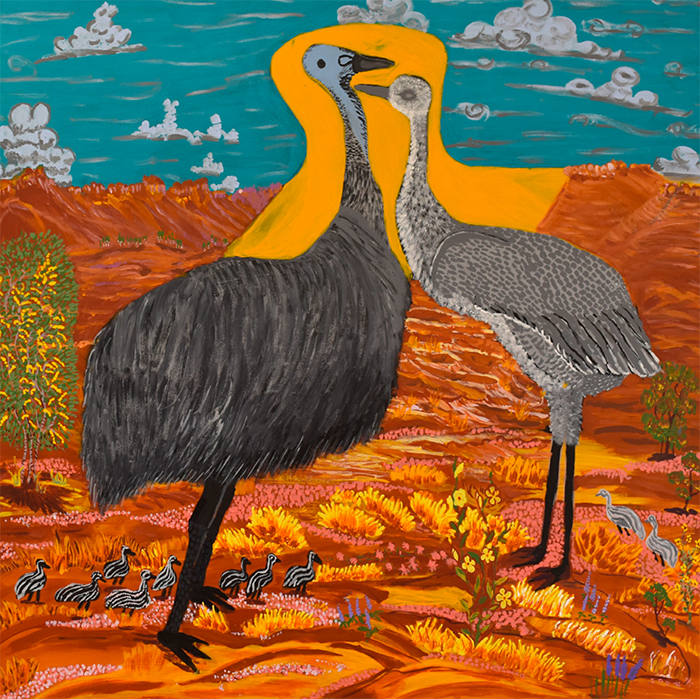
Liturwarti, 2023, acrylic paint on canvas, 120 × 120cm
Courtesy the estate of the artist and Mankaja Arts, Western Australia
As the artist will never see the show, Kinsella acknowledges there will be a depth of loss, but fundamentally, a strident desire to display how important Greene is as an artist and cultural ambassador – always in control of her story. Kinsella concludes: “what a great thing to celebrate in a space dedicated to Australian women artists.”
Emma-Kate Wilson is an art and design writer and editor based on Gumbaynggirr Country (Bellingen, New South Wales).
Lawrence Wilson Art Gallery
14 February to 4 April 2026
Western Australia
Originally published in print – Art Almanac, February 2026 issue, pp. 16–19