“. . . reflecting on stories, culture, and identity.”
Curated by Lucy Latella, Primavera 2024: Young Australian Artists highlights the practice of five artists – a smaller number than in previous years, allowing a focused energy on each artwork, to consider individual narrative so that a shared dialogue organically forms. This is Australian art today, reflecting on stories, culture, and identity.
“The practices are very different, but they do have a number of common threads: storytelling and intergenerational exchange, inheritance and belonging,” says Latella. “They build an autobiographical archive, and that’s important to each artist in different ways.” These ideologies underpin the exhibition in a varied mix of materiality ranging from shells to terracotta, silk banners to aluminium. The materials are often a source of connection to homelands and ancestry. “I was particularly drawn to artists who are turning to making and materiality to strengthen ties with their family community, while also shaping their own identity,” continues Latella.

Monica Rani Rudhar, We Were Connected in a More Complicated Way Than Either of Us Could Even Begin to Understand, 2023, installation view, Primavera 2024: Young Australian Artists, Museum of Contemporary Art Australia, Sydney, 2024, single-channel video. © the artist. Photograph: Zan Wimberley. Courtesy the artists and Museum of Contemporary Art Australia, Sydney
In the centre of the exhibition, Latella describes Monica Rani Rudhar’s video installation as “the heart of the exhibition.” In We Were Connected in a More Complicated Way Than Either of Us Could Even Begin to Understand, 2023, Rudhar narrates the story of her mother and her beloved pet cow (also called Monica). A source of comfort for her Romanian-born mother, the cow becomes representative for the divine in Rudhar’s father’s Hindu heritage. The video work is joined by an installation of oversized jewellery adorning the walls. Hoops That Once Belonged To My Mother, 2022, and Earrings That My Mother Kept For Me, 2024, feature lost and kept heirlooms monumentalised in terracotta.
In Teresa Busuttil’s installation sinners grotto, 2023, an old boat is inlaid with shells for a womb-like experience, surrounded by purple and pink hues for a dreamy, reflective space. “The slow mosaicing of the boat was a deeply reflective, personal process for the artist,” adds Latella. Busuttil explores a recognised cultural identity from her late father’s homeland, yet with a reframing for a sense of self joined by new works made in Malta: Jesus was a Capricorn, 2024, Over Sea (Self Portrait), 2024, and Isimghu (Listen), 2024.
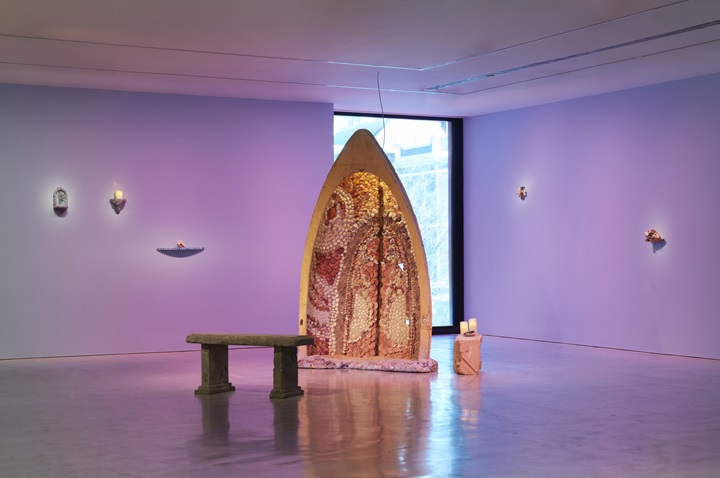
Teresa Busuttil, installation view, Primavera 2024: Young Australian Artists, Museum of Contemporary Art Australia, Sydney, 2024. © the artist. Photograph: Zan Wimberley. Courtesy the artists and Museum of Contemporary Art Australia, Sydney
Continuing the pastel hues and connection across oceans, Chun Yin Rainbow Chan’s installation Long Distance Call, 2024, features silk painting, animation and a soundscape that samples a ringing telephone. The work muses on the international calls between Chan’s mother and late aunt. The relationship spanning countries and continents, immediate family ties, and grounded in their ancestral connection to the Weitou people of Hong Kong. The memories that remain and the ones that change shape in time.
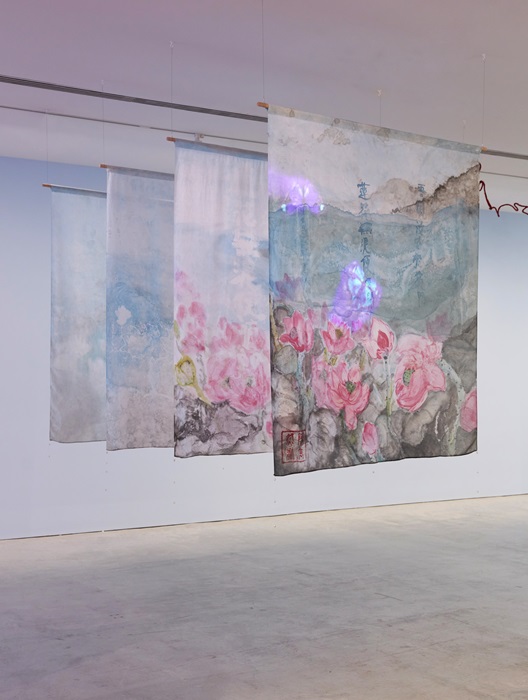
Chun Yin Rainbow Chan (陳雋然), Long Distance Call 長途電話 (detail), 2024, installation view, Primavera 2024: Young Australian Artists, Museum of Contemporary Art Australia, Sydney, 2024, silk dye on habotai silk, wax resist, freshwater pearls, linocut print, jute twine, digital animation projection, audio track. © the artist. Photograph: Zan Wimberley. Courtesy the artists and Museum of Contemporary Art Australia, Sydney
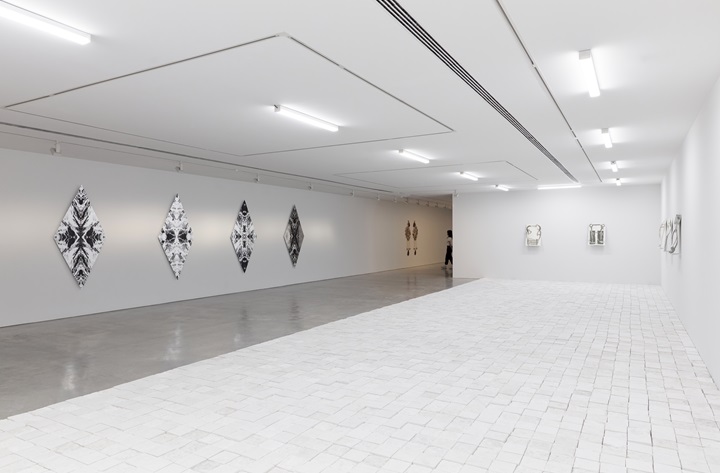
Aidan Hartshorn (left) and Sarah Ujmaia (right), installation view, Primavera 2024: Young Australian Artists, Museum of Contemporary Art Australia, Sydney, 2024. © the artists. Photographs: Zan Wimberley. Courtesy the artists and Museum of Contemporary Art Australia, Sydney
For the only non-international dialogue, Aidan Hartshorn instead turns to his Walgalu and Wiradjuri ancestry for Yiramir Mayiny (River People), 2024. The artist crafts four large diamond shields from industrial aluminium to speak to the disruption of the Snowy Hydro in the High Country of Australia, describing the scheme as “weaponising the Walgalu ancestor, Bila (Water)” through the manipulation of rivers that feed into the dam. The reflective forms in the gallery are heartbreakingly beautiful reminders of how globalisation and colonisation disrupt ancient methodologies.
Finally, Sarah Ujmaia – a first-generation Chaldean woman and the first of her family to be born in Australia, following their migration from northern Iraq – presents And thank you to my baba for laying the timber floor, 2024, an ethereal installation that connects the senses to materiality. The audience is invited to walk over nearly 4,000 pavers made from fired and unfired shell grit; materials that form limestone, which in turn can become marble over millennia. It’s here she evokes the process of turning raw materials into valued stone, and how oral languages evolve across generations.
The joy of this year’s Primavera is how it connects intergenerational stories, using a varied materiality that keeps dialogues churning in new directions. Repeatedly, it’s a reminder of how everyday stories can be elevated to serve history. And how histories and identities should be honoured in Australia’s multicultural narrative.
Emma-Kate Wilson is an art and design writer and editor based on Gumbaynggirr Country (Bellingen, New South Wales).
Museum of Contemporary Art Australia
30 August 2024 to 27 January 2025
Sydney
Originally published in print – Art Almanac, November 2024 issue, pp. 26–28


