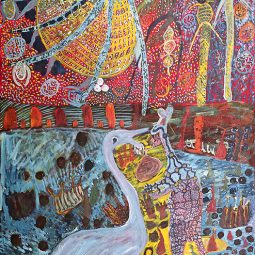
Can art stop a war or save a life? Yes, art can contribute to stopping wars and saving lives as it turns a mirror on the horrors of war and through this act of exposure brings people to their senses.
Picasso’s Guernica, 1937, exposed the brutal face of fascism with screaming women and a dead baby and it became an icon of antiwar art. During its long period of exile at the Museum of Modern Art in New York, it was the site of vigils during the Vietnam War. Picasso stipulated in his will that the painting should not return to Spain until democracy was restored to the country. When the painting finally came home to Madrid, it was displayed behind bomb- and bullet-proof glass screens with armed soldiers standing at either end of the painting. Such is the power of art.

Image from I have loved/I love/I will love, 2025, giclée print on paper, 195 x 150cm
© Pat Hoffie
Photograph: Nina White
Courtesy the artist and Queensland Art Gallery, Brisbane
Pat Hoffie, one of Australia’s most admired socially engaged artists, whose career spans half-a-century, has created Australia’s Guernica – a massive and powerful installation, I have loved/I love/I will love. In the centre of the room stands a scaffolding made of ladders shown as a futile attempt to escape from the rubble of destroyed homes. The viewer quickly realises that for those trapped in this war, there is no way out.

Installation view of Pat Hoffie: I have loved/I love/I will love at Queensland Art Gallery, Brisbane, 2025
Photograph: N Umek
© QAGOMA
Courtesy the artist and Queensland Art Gallery, Brisbane
On the walls surrounding this central installation are huge, multitiered images of the horrors of war. Most of these images are realised as prints – mainly large-scale drypoints and monotypes – printed with the assistance of the artist printmaker Tim Mosely at the Cobalt Editions Print Studios. Hoffie, like most of us over the past couple of years, has been bombarded with digital images of excruciating pain and suffering endured by the people of Gaza. By translating these images into traditional analogue printmaking techniques, she makes them more human, tangible and accessible. However, it is not enough to capture images of horror, there is also a need to translate them into a language that will memorialise them and give them the breath of humanity.

Image from I have loved/I love/I will love, 2025, giclée print on paper, six panels: 377 x 535cm (overall)
© Pat Hoffie
Photograph: Nina White
Courtesy the artist and Queensland Art Gallery, Brisbane
Hoffie, as a strategy in her art, turned to the work of other artists who had witnessed the horrors of war, especially Jacques Callot, Francisco Goya, and Käthe Kollwitz, and used their work as a filter for suffering humanity. Goya created his series of prints The Disasters of War, 1810–20 that dealt with the brutal consequences of the Napoleonic occupation of Spain with images of war, famine and political intrigue. The titles of his prints read: And they are like wild beasts, Is this what you are born for? Bury them and be silent, This is not to be looked at, Ravages of war, Why? For the common grave! Cartloads for the cemetery, Truth is dead. And he punctuates this with captions I saw this, And that too.

Image from I have loved/I love/I will love, 2025, giclée print on paper, 65 x 100cm
© Pat Hoffie
Photograph: Nina White
Courtesy the artist and Queensland Art Gallery, Brisbane
Hoffie adopts this idea of art as witness to the horrors of war. Her work is enormously powerful, challenging and gut wrenching. Bodies of children in the rubble of their homes, starving women with their empty bowls begging for food and the toll of innocent victims. These are the disasters of war in Gaza distilled and exposed in an attempt to stop wars and to save lives.
Emeritus Professor Sasha Grishin AM, FAHA works nationally and internationally as an art historian, art critic and curator.
Queensland Art Gallery
30 August 2025 to 1 February 2026
Brisbane
Originally published in print – Art Almanac, December 2025 / January 2026 issue, pp. 22–25