In 1953, during the post-World War II wave of European migration to Australia, Theo Koning, aged three, travelled from Holland to Fremantle, Western Australia, along with his parents and brother, aboard the MS Sibajak.
Koning and his family settled in Perth and after he left school, he decided to do an apprenticeship in wood machining and joinery – skills he had acquired while helping his father renovate the family home. At the same time, he also enrolled in part-time art classes. Then, in 1971, soon after completing his apprenticeship, he started full-time art studies at Claremont Technical College, despite his father wondering how his son would earn a living.
His father need not have worried. Over the next fifty years, Koning would become known for his work across sculpture, drawing, printmaking, and painting. He made, for instance, sculptural assemblages from discarded objects and found materials that he scavenged from skip bins, op shops, school fetes, and detritus found on the roadside or along the seashore. In these works, humour was a vital element, and they also challenged conventional notions of what could be considered art.
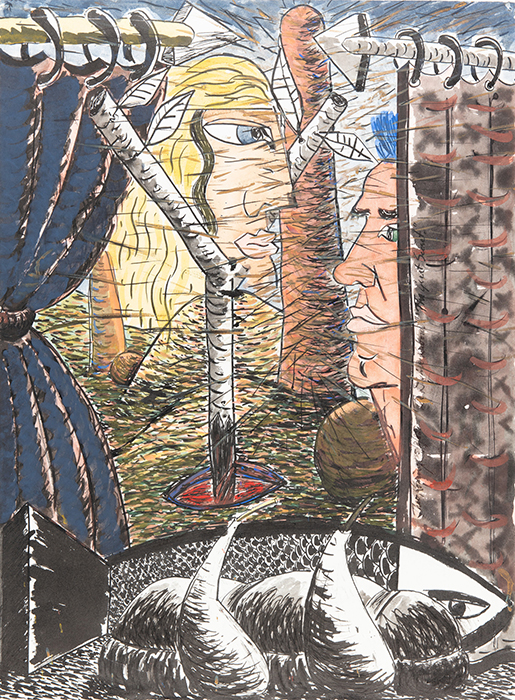
Theo Koning, The Divine Labour The Great Secret, 1985, pen, ink, and gouache, 56.5 × 76.5cm (sheet and image)
The State Art Collection, Art Gallery of Western Australia. Purchased for the Guy Grey-Smith Memorial Collection, 1986
Photograph: Bo Wong
Courtesy Art Gallery of Western Australia, Perth
Koning, who died in 2022, is represented in the permanent collections of major galleries, such as the Art Gallery of Western Australia (AGWA) in Perth. One of his mixed-media artworks of pen, ink, and gouache, The Divine Labour The Great Secret, from 1985, is currently on display in an exhibition Theo Koning: Object Syntax. At AGWA, Associate Curator of Contemporary Art, Isobel Wise, says this work highlights Koning’s contribution to Western Australia’s contemporary art history and is significant in the artist’s mid-1980s practice. “By this time Koning was developing a two-dimensional graphic vocabulary that both related to, and responded to, his sculptural work – part personal mythology, part social commentary – where recurring motifs function like components of a coded syntax. Side-profile portraits, curtains, a branching Y-form, a fish shape, and other emblematic elements are arranged in a manner that acknowledges and undoes depth of field, appearing at once measured and enigmatic.”
Wise says she finds The Divine Labour The Great Secret striking in the way it holds tension and clarity simultaneously. “On one hand, the motifs are highly recognisable, shapes that feel connected to both metaphor and daily life. On the other hand, the way Koning arranges them refuses an easy reading. I’m drawn to how the curtains operate theatrically – part revelation, part concealment – mirroring the way we negotiate what we show and protect within ourselves. The branching Y-shape feels like a point of decision or divergence, something organic and psychological that defies rules of perspective to exist across all layers at once. I find the work both grounding and gently destabilising. It asks me to slow down, to consider how meaning is built from fragments, and how we read signs based on our own experiences. There’s a generosity in this ambiguity. Koning isn’t telling us what to think but offering a structure through which reflection can take place.”
Bronwyn Watson has been writing about visual arts for leading newspapers and magazines for over thirty-five years.
Art Gallery of Western Australia
On display in Theo Koning: Object Syntax 20 December 2025 to 19 July 2026
Western Australia
Originally published in print – Art Almanac, February 2026 issue, pp. 28–29