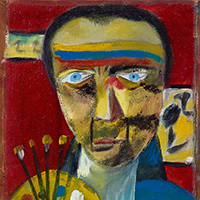
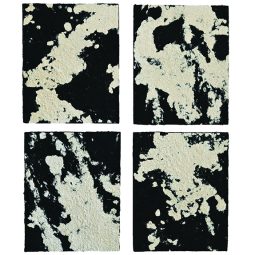
The paradox of Auguste Rodin (1840-1917) remains unresolved even a century after his death. He resurrected the passion of antiquity, yet pioneered modernist methods. His career was long and lauded by the artistic establishment, but retrospectively cast among the vanguard of cultural disobedience. His name, to this day, is synonymous with monumental sculpture, despite a love of literature and intuitive illustrations.
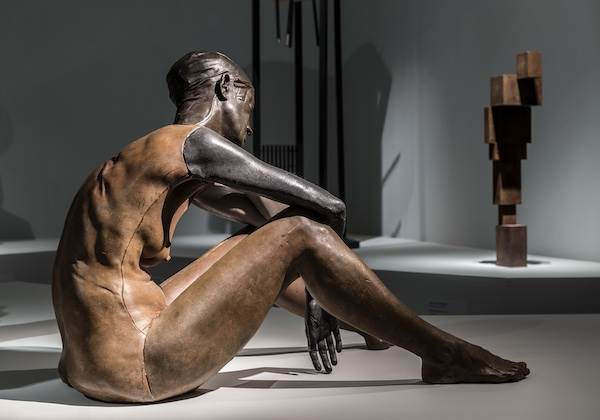
Versus Rodin: bodies across space and time’, installation view Art Gallery of South Australia, 2017 featuring Ugo Rondinone, nude (xxxxxxx), 2010, Antony Gormley, Small prop III, 2013 and Ben Leslie, Untitled (The House of Vulture), 2016. Photograph: Saul Steed. Courtesy Art Gallery of South Australia, Adelaid
This confluence at the Art Gallery of South Australia (AGSA) is central to the premise of ‘Versus Rodin: Bodies across space and time’. Curator Leigh Robb presents the largest Rodin collection in the southern hemisphere in dialogue and debate with modern and contemporary art. Thematic rooms assemble works in a range of media amongst Rodin sculptures. Notable conversations occur between the artist’s monumental nudes and Antony Gormley’s pixelated figures, such as Clutch (2007) precariously balanced on its haunches. The black lustre and despair of Pierre de Wissant, Monumental Nude (c.1886-87) finds companions in the luminous repose of Kehinde Wiley’s After Jean Bernard Restout’s ‘Sleep’ (2009) and Paul Pfeiffer’s soaring athlete in Four Horsemen of the Apocalypse, No. 18 (2004).
Rodin’s drawings for Octave Mirbeau’s provocative novel ‘The Torture Garden’ (1899) are an unexpected delight, revealing the artist’s subtlety and spontaneity. He purportedly sketched with his eyes on the model, hands moving in autonomous gestures. These opaque figures fall softly on the page, a blush of watercolour implying vitality and virility.
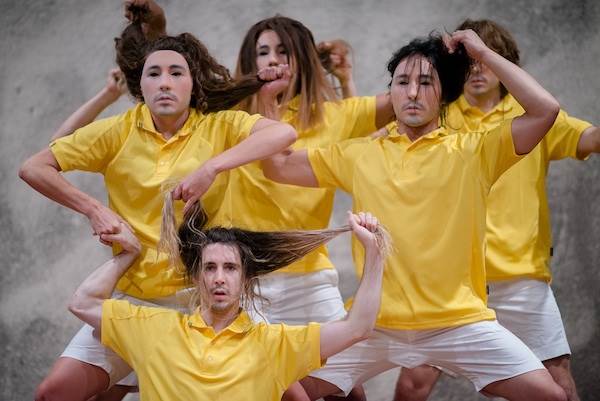
Garry Stewart and Australian Dance Theatre, Doppelgänger, March 2017, Versus Rodin: bodies across space and time, Art Gallery of South Australia. Photograph: Nat Rogers
The ‘body across space and time’ gallery ushers visitors along a sunken path between raised plinths. The Three Shades (1881-83) lower their heads in a pact, fists joined like the hub of a wheel. Rodin assembled the trio of life, death and rebirth from multiple models of the same figure. This freeing act of repetition is animated in a performance by the Australian Dance Theatre (ADT), Doppelganger (2017), commissioned for the exhibition.
Garry Stewart, ADT Artistic Director, draws inspiration from the morphology and psychological drama of Rodin’s figures. Dancers enact the negotiation of identity between the individual and the group. A single face is repeated in masks, the real visage glimpsed among its twin selves. “Touch extends one’s body into another’s body,” Stewart says, evoking Sara Rahbar’s Keep me, Sustain me (2015) where a bronze hand suspends its partner in a gentle caress.
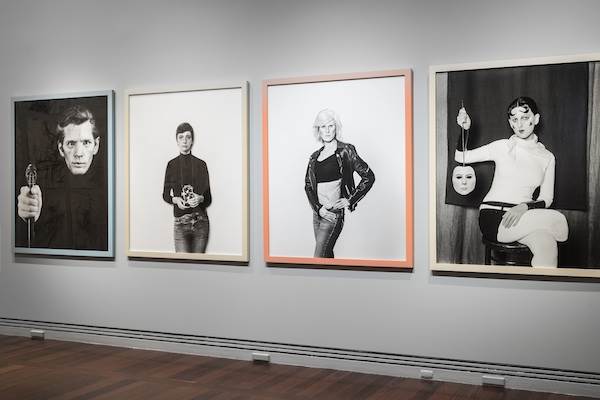
Installation view ‘Versus Rodin: bodies across space and time’, Art Gallery of South Australia, featuring Gillian Wearing, Me as Mapplethorpe, 2009, Me as Arbus, 2008, Me as Warhol in Drag with Scar, 2010, Me as Cahun Holding a Mask of My Face, 2012. Photograph: Saul Steed
Masks are central to Gillian Wearing’s life-size portraits featuring herself as celebrities. Adopting their fashion and idiosyncrasies, she creates both an ode to, and a pastiche of, their personality. The junction and fracture of identity is also explored in Xu Zhen’s Eternity (2013-14). Headless reproductions of religious statues from Asian and European temples are fused at the neck. This gravity-defying sculpture dominates AGSA’s exhibition atrium.
Multiple works by Australian contemporary artists such as Bill Henson and Yhonnie Scarce feature alongside Julia Robinson’s fine needlework. The loud wound (2015) is a powerful statement of maternal grief inspired by the Finnish epic Kalevala (1835) in which a tale tells of a mother’s futile attempt to repair her dismembered son. Robinson’s textile form gains mortal weight from half a bushel of wheat. Sharp, steel rods pierce the fabric spilling pearls of grain upon the floor.
While these (and other) important works are worthwhile viewing in their own right, the relevance of Rodin is lost at times among broad themes. The significant number of artworks installed in each gallery makes for a diverse but somewhat dizzying exhibition. A large publication provides clarity about Rodin’s paradox with notable essays from Richard Beresford, Maria Zagala and Lisa Slade.
Liv Spiers is a writer based in Adelaide.
Art Gallery of South Australia
Until 2 July, 2017
Performances by the Australian Dance Theatre on 9, 10, 16 and 17 June, 2pm
Adelaide