A colossal, naked pregnant woman stands on the gallery floor, looking utterly exhausted from the weight in her womb. There is a faint sheen of sweat glistening on her brow and with lips parted she’s on the cusp of an infinite, weary sigh. Viewed front on, the exaggerated size of the 252cm tall woman forces her burdensome belly upon the spectator as we imagine the baby concealed within. Yet such imaginings are checked by the suspicion that beneath her plastic stomach is nothing but a hollow space. Here, Ron Mueck’s sculpture Pregnant Woman (2002) breaches the borders between the real and the unreal, and this is the kind of subversive verisimilitude signature to the National Gallery of Australia’s (NGA) summer exhibition.
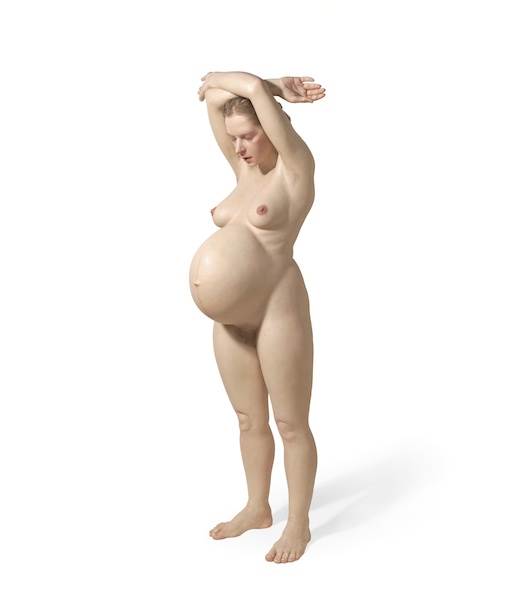
Ron Mueck, Pregnant woman, 2002, mixed media, 252 x 78 x 72cm National Gallery of Australia, Australian Capital Territory. Purchased with the assistance of Tony and Carol Berg, 2003. © Ron Mueck. Courtesy the artist, Anthony d’Offay, London and Hauser & Wirth and National Gallery of Australia, Australian Capital Territory
Featuring over 50 artworks by 32 Australian and international artists, ‘Hyper Real’ traces the artistic genome of hyperrealism since the early 1970s. Confronting the viewer with a horde of human homologues that appear ‘more human than human’ like Blade Runner replicants, the anthropocentric presentation unsettles our psychic equilibrium in ways that echo Sigmund Freud’s speculations about the uncanny, where distinguishing between fantasy and reality is famously problematic.
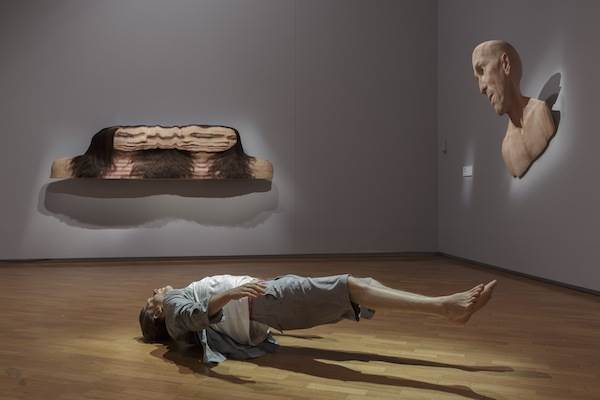
Installation view of Hyper Real at the National Gallery of Australia, Australian Capital Territory
The genre’s forefather, American artist Duane Hanson, is represented in the show with his mimetic sculpture Woman with a laundry basket (1974), an ultra-realistic life-sized figure that appears to have accidentally time-travelled into the gallery space during a mundane, domestic task. Meanwhile, in Sun Yuan & Peng Yu’s Old people’s home (2008), a gang of withered, senile world leaders sluggishly roll about the gallery in their electric wheelchairs, crashing into each other at random. Their arbitration between fibreglass and flesh carves out an intermediary zone where binaries collapse; human and inhuman, animation and inertia, the natural and the artificial. This destabilising mimicry is continued in Marc Quinn’s ongoing self-portrait, an encased frozen head comprising litres of the artist’s own blood. Recast every few years to trace Quinn’s aging, this abject ‘death mask’ crystalises the proximity between life and lifelessness haunting human existence.
‘Hyper Real’ is part of a travelling exhibition that has already been shown in Spain, Mexico and Denmark, yet its NGA iteration has been expanded by curator Jaklyn Babington to represent eight Australian artists. Among these, a new installation by Patricia Piccinini presents anthropomorphic hybrids in a mirrored room, creating an endless process of replication that recalls Jean Baudrillard’s formative ideas about hyperreality as a virtual image regime of ‘simulacra’. In Sam Jinks’ sculpture The deposition (2017) – commissioned for the exhibition – a naked middle-aged man rests his head in his elderly mother’s lap, comforted by her touch (hands cast from Jinks’ 92 year-old grandmother). The diminutive woman is both a pillar of strength and a frail image of mortality, prompting the viewer to question, in a composition that is at once secular and sacred, who is being deposed; the mother or son.
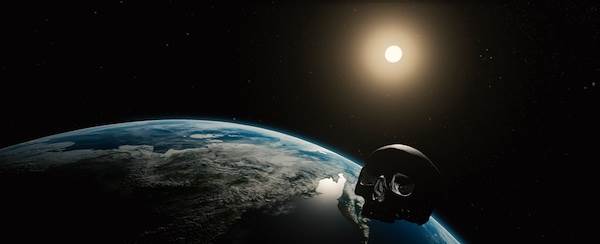
Shaun Gladwell, Orbital vanitas, 2017, virtual reality: computer-generated animation, 6:00 minutes, sound, colour. Produced by BADFAITH. Courtesy the artist, Anna Schwartz Gallery, BADFAITH and National Gallery of Australia, Australian Capital Territory
In addition to the uncanny humanoids on display, the exhibition showcases recent developments of the hyperreal genre in the digital realm. Shaun Gladwell’s virtual reality experience Orbital vanitas (2017) takes us on a disembodied voyage through space inside a giant planetoid skull, pushing the tradition of memento mori to an all-too-real dimension. An immersive 360° video installation by Russian collective AES+F, Inverso mundus (2015), literalises the 16th century historical engravings of the same title (translating to ‘The World Upside Down’) by presenting disconcerting visions of a subverted, posthuman society. Hybridised creatures float in an airless sky and flawless cleaners shower the city with debris while anthropomorphised pigs slice open hanging human butchers and redhead centaurs are the new mode of transport. This is a world where utopia and dystopia find equilibrium.
‘Hyper Real’ taps into a growing stream of existential anxieties regarding the ontological configuration of Homo sapiens in a world where previously established boundaries between the human body as biological organism and as synthetic construct are dissolving more rapidly and saliently than in previous phases of modernity.
Elli Walsh is an arts writer based in Sydney.
National Gallery of Australia
Until February 18, 2018
Australian Capital Territory