In 1955 Milan-based architect Enrico Taglietti arrived in Sydney on a Qantas flight to present an Italian design exhibition at department store David Jones. Once in Australia, he and his wife Franca initially never expected to settle here, but a year later they decided to live permanently in Canberra. Unlike others who considered the national capital little more than empty sheep paddocks, Taglietti found a tiny city brimming with potential. Commenting on this, Taglietti once said: “In Canberra there were definitely no constraints . . . I had a sense of infinity.”
Taglietti, who was born in Milan in 1926, grew up in Ethiopia but returned to his hometown to study architecture under mentors such as Pier Luigi Nervi and Bruno Zevi. Over his sixty-year career in Canberra, Taglietti designed schools, libraries, houses, commercial buildings such as the Canberra Cinema Centre, and embassies including Italy and Pakistan. In 2007 he was awarded the Australian Institute of Architecture’s Gold Medal.
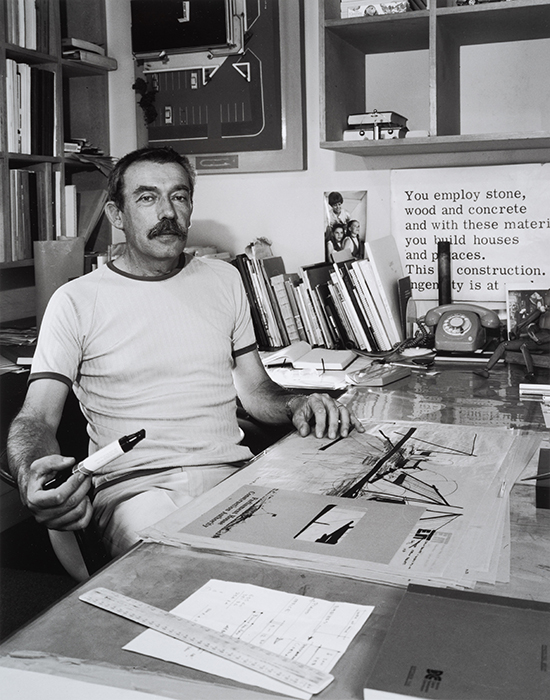
Ted Richards, Enrico Taglietti in his studio, 1979, silver gelatin print, 35.6 × 27.9cm / Collection Canberra Museum and Gallery. Purchased 2013
In 1979 photographer Ted Richards took a picture of Taglietti in his Canberra studio. This image is in the collection of the Canberra Museum and Art Gallery and is currently on display in Taglietti: Life in Design, as part of a reconstruction of the architect’s studio. Senior curator Virginia Rigney says that to enter Enrico’s studio was to step into his creative world – a vibrant space where current projects jostled with beloved objects, artworks, and handmade pieces. “In this image Enrico is holding his distinctive black marker pen,” she says. “Some other interesting details include the family portrait of his wife Franca and daughters Tabitha and Tanja, and the model of the Wagga Wagga Townhouse hotel. It was this project that was included in the landmark exhibition Transformations in Modern Architecture at the Museum of Modern Art in New York in 1979. The wooden figure sitting on the chair was from Enrico’s student days in Milan and served as a reminder to always design for human scale. The quotation behind him is about celebrating that architecture is not construction but art.”
Taglietti embodied the spirit of the global architect, Rigney says. “His design language fused influences from Italy, Ethiopia, and Australia and beyond, and his work blends a sculptural use of light, thoughtful materiality, and bold spatial experiences. He was a deeply committed advocate for Canberra’s architectural future, proposing bold ideas which were all grounded in a deep respect for the 1913 Marion and Walter Burley Griffin plan. He believed that great cities are the embodiment of dreams and the product of imaginative design, not just the product of planning metrics.”
Bronwyn Watson has been writing about visual arts for leading newspapers and magazines for over thirty-five years.
Canberra Museum and Gallery
On display in Taglietti: Life in Design, 7 June 2025 to 3 May 2026
Australian Capital Territory
Originally published in print – Art Almanac, April 2026 issue, pp. 30–31