In 1945, seventeen-year-old Eva Kubbos moved from her small rural hometown in Lithuania to East Berlin to study for five years at the College of Applied Art, where she had a strict, eight-hours-a-day, academic training focused mainly on German expressionism. During this time one of her ideas was to go behind stage at the theatre, and she produced lithographs and illustrations of Bertolt Brecht’s famous play, Mother Courage and Her Children. The subsequent exhibition of her work was a sell-out.
Although Kubbos had friends in Berlin and was doing well at art school, she had little money and often went without food. “I remember the winter was very severe, and my room was not heated, and my fingers were all frozen because you can’t work with gloves,” she later recalled. “Then, after the war, the poverty, and always sad situations that you saw on the street, all these limbless people and blind people. It was very, very hard.”
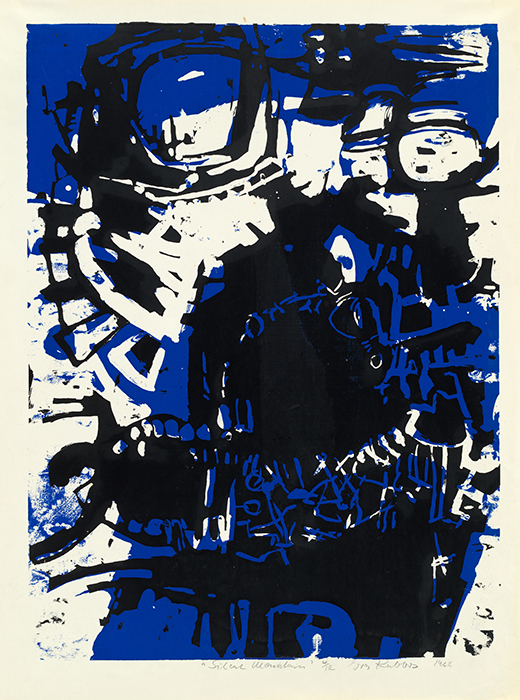
Eva Kubbos, Silent mountain, 1962, screenprint, printed in colour inks, from two stencils, edition 4/12, 73 × 53.7cm (printed image) / National Gallery of Australia, Kamberri Canberra / Gift of Eva Kubbos, 1988
Kubbos decided she wanted to move to a place that was warmer and not overpopulated. “I wanted to get away from it all; that was my greatest desire,” she said. “I chose Australia because I thought it was so far away and, in my mind, I thought it could be a very attractive country. I thought it seemed to be unspoiled and, of course, as a young person you thought of these exotic things like exotic plants and exotic animals like the kangaroo and all the other little creatures that you find.”
In 1952 Kubbos migrated to Australia with her sister Marta. After working at jobs like fruit picking and advertising, in 1956 she continued her art studies in Melbourne, firstly at RMIT and later Swinburne Technical College. In 1960 she moved to Sydney where she met fellow Lithuanian artist Henry Salkauskas, who became her friend and mentor. She also became part of a group of émigré artists who brought with them a European avant-garde sensibility, notably in the field of printmaking. By this stage Kubbos was interested in abstract expressionism and was working across a range of mediums such as lithography, linocuts, acrylic, and watercolour. She showed at the landmark First Australia-Wide Graphic Art Exhibition, 1960, organised by the Contemporary Art Society, and in 1961 co-founded the Sydney Printmakers, which further fostered the printmaking medium.
Over her career, Kubbos has won numerous awards, and she is represented in collections such as the Art Gallery of New South Wales and the National Gallery of Victoria. Kubbos’s work is also in the collection of the National Gallery of Australia in Canberra and one of her screenprints, Silent mountain, is currently on display in an exhibition Migration and modernism: Émigré artists in post-war Australia. At the National Gallery, Curator, Australian art, Rebecca Edwards, says that Kubbos was significant because she was an important figure in Australian printmaking in the 1960s and played a key role in the print revival during this era. “She arrived in Australia with existing expertise in printmaking and joined a dynamic and supportive network of artists in Sydney with an interest in the medium and together these artists elevated and advocated printmaking as an artform equal to painting through exhibitions and education.”
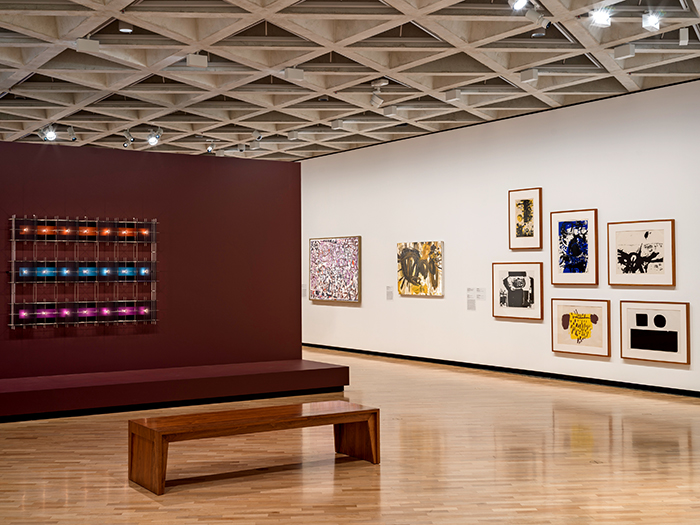
National Gallery of Australia, Migration and modernism: Émigré artists in post-war Australia installation view
Silent mountain is a characteristic and highly resolved example of Kubbos’s printmaking in the 1960s, combining stylistic traces of abstract expressionism, her childhood memories of the stark Lithuanian landscape, and her impressions of Australia, Edwards says. “Silent mountain forms part of a substantial corpus of works which brings some or all these ideas together. In Migration and modernism this work is hung alongside prints by Henry Salkauskas and German Udo Sellbach, all of whom formed part of the postwar diaspora and played important roles in the print revival as artists, advocates, and teachers.”
Bronwyn Watson has been writing about visual arts for leading newspapers and magazines
for over thirty-five years.
National Gallery of Australia
On display in Migration and modernism: Émigré artists in post-war Australia
until 7 March 2027
Australian Capital Territory