In the late 1960s, Ron Robertson-Swann, now one of Australia’s best-known sculptors, returned to Sydney following his post-graduate studies with prominent British sculptor Anthony Caro at St Martin’s School of Art in London. “Caro was enormously encouraging of me . . . and we had lots of arguments about things like colour,” Robertson-Swann recalled later. Also influential was the three years he spent working as an assistant to preeminent sculptor Henry Moore. Robertson-Swann’s time in England, as well as his earlier studies with Lyndon Dadswell at East Sydney Technical College (now the National Art School), was a formative period comprising a move towards abstraction and experimentation with colour and new materials such as welded steel.
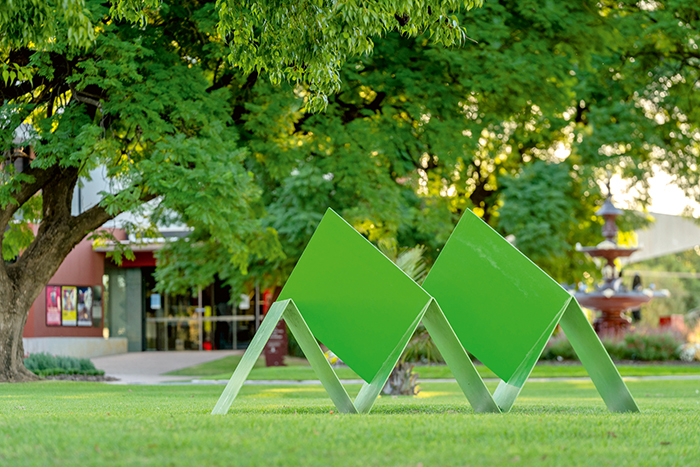
Ron Robertson-Swann, Beethoven, 1963 (recreated 1968), painted steel, 137 × 274 × 91cm /
Mildura Arts Centre Collection / 4th Mildura Sculpture Triennial, 1970
Not long after Robertson-Swann’s return to Sydney in 1968, he created a large-scale, green-coloured sculpture constructed from painted steel, which he exhibited in 1970 at the landmark 4th Mildura Sculpture Triennial where it was selected by the acquisitions judging panel for acquisition into the Mildura Arts Centre Collection. This sculpture, Beethoven, is now on permanent display in Mildura, a city on the banks of the Murray River in northwest Victoria. At the gallery, Luci Callipari-Marcuzzo, Mildura Arts Centre Gallery and Heritage Team Leader, says that Beethoven is a significant work which represents a key moment not only of Robertson-Swann’s career but also within the broader history of Australian sculpture. “Created at a moment when sculpture in Australia was moving decisively towards abstraction, Beethoven exemplifies the embrace of industrial materials and formalist principles that characterised the late 1960s,” Callipari-Marcuzzo says. “Beethoven demonstrates Robertson-Swann’s rigorous exploration of balance, spatial tension, and geometric form, translating ideas of rhythm and harmony into three-dimensional space. The musical title suggests an interest in translating non-visual structures – such as rhythm, tempo, and compositional order – into sculptural form, aligning with Robertson-Swann’s commitment to abstraction as a universal visual language.”
More recently, Beethoven was the focus of media attention thanks to a tongue-in-cheek tourism campaign by Mildura council. Fronted by actor Shane Jacobsen, the campaign called on Melbourne City Council to “give” Robertson-Swann’s well-known 1980 bright yellow sculpture, Vault, to the City of Mildura, suggesting the sculpture was underappreciated in Melbourne. The promotion included a mock heist of Vault to join Beethoven in the Mildura Arts Centre Sculpture Park.
As for Beethoven, Callipari-Marcuzzo says it is one of the most loved and immediately recognised works in the collection and is used as the inspiration for the Mildura Arts Centre logo. “Beethoven is not only a formally accomplished work of modernist sculpture, but its iconic green colour gives the sculpture a strong visual presence, allowing it to stand out against the built and natural environment. The work’s three distinct components, which come together to form a unified whole, invite close looking and reward repeated encounters. Beethoven stands as a compelling example of the bold, materially confident works that defined this period.”
Bronwyn Watson has been writing about visual arts for leading newspapers and magazines for over thirty-five years.
Mildura Arts Centre
On permanent display in Mildura Arts Centre Sculpture Park
Victoria
Originally published in print – Art Almanac, September 2026 issue, pp. 30–31