In his current solo exhibition titled ‘Baby It’s Cold Outside: The Remix World of…’ at Melbourne’s Lesley Kehoe Galleries, Brooklyn-based Japanese artist Tomokazu Matsuyama continues to import and reinterpret Edo Period imagery through a global contemporary lens. Growing up in the historic, mountainous town of Hida-Takayama, Japan, Matsuyama became a collector of traditional Ukiyo-e woodblock prints, an aesthetic that percolated and colours his work today.
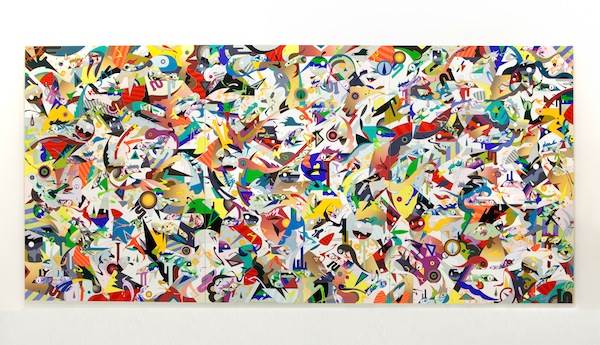
Tomokazu Matsuyama, Keep Fishin’ For Twilight, 2017, acrylic and mixed media on canvas, 210 x 450cm. Photograph: Yojiro Imasaki
Using acrylic and mixed media on canvas, his paintings inject a pyrotechnic display of pachinko-pop hues particularly in the pieces Mid Night Patience (2017), Hope It Wasn’t Me (2017), and Keep Fishin’ for Twilight (2017). The latter, his largest on view, stands like a colossal collage of sliced clip-art JPEGs sardined into a single canvas too small for its size. Perhaps the composition of the work and its electric palette query our hyper-visual culture, including the abundance of multiple virtual realities existing in the same digital ecosystem.
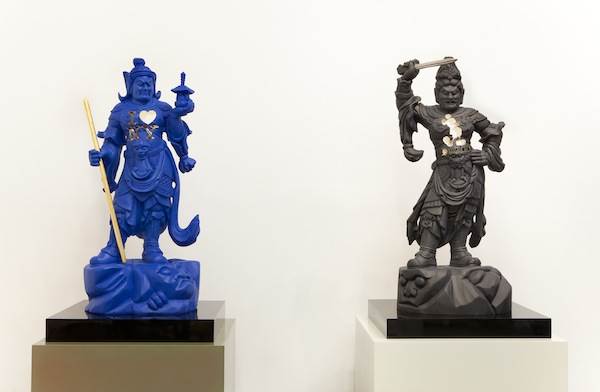
Left: Tomokazu Matsuyama, Bon Voyage #NY, 2017, edition 2 of 3, Dupont Renshape, polyurethane paint and gold foil, 120 x 60 x 60cm Right: Tomokazu Matsuyama, Bon Voyage #LA, 2012, edition 1 of 3, Dupont Renshape, olyurethane paint and gold foil, 120 x 60 x 60cm. Photograph: Yojiro Imasaki
Looking elsewhere, but not straying too far from the artist’s eclectic mayhem of Edo Period art redux, the exhibition also features his most recent sculptural works. Bon Voyage (NY & LA) (2017) is a diptych with 22 karat gold leaf American iconography stenciled onto the amour of two warrior deities ready for assault. Like many of Matsuyama’s works that “remix elements from the multicultural world”, these statues draw inspiration from tourist paraphernalia and East Asian Buddhism.
Your compositions are almost kaleidoscopic, is there an interest in synaesthesia in your approach?
Not directly. However, I do want people from all cultures, age groups and demographics to have an immediate cognitive response to my work and recognise something that feels familiar to them. My work is about cultural identity, and how borders are merging and changing through Internet culture. It is therefore very important for me to have internationally and instantaneously recognisable elements in my work.
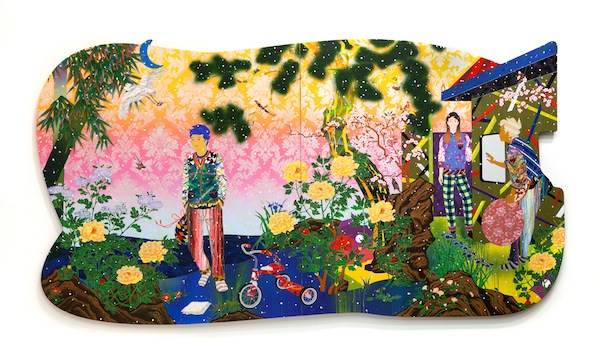
Tomokazu Matsuyama, Baby It’s Cold Outside, 2016, acrylic and mixed media on canvas, 200 x 370cm. Photograph: Yojiro Imasaki
Can you tell me about your use of colour, in particular your preference for opaque and bright pigments?
In the 1980s, I spent some time at a school in Orange County, California. This was during the advent of California’s skateboarding, B-Boy and surf culture, as well as heavy metal music and glam rock. Brands like Stussy and Kid Sister became iconic for their fluorescent hues, busy patterns and brightly coloured fashion. This inspired me because it was in complete contrast to the simplicity of Japanese fashion and culture I was used to.
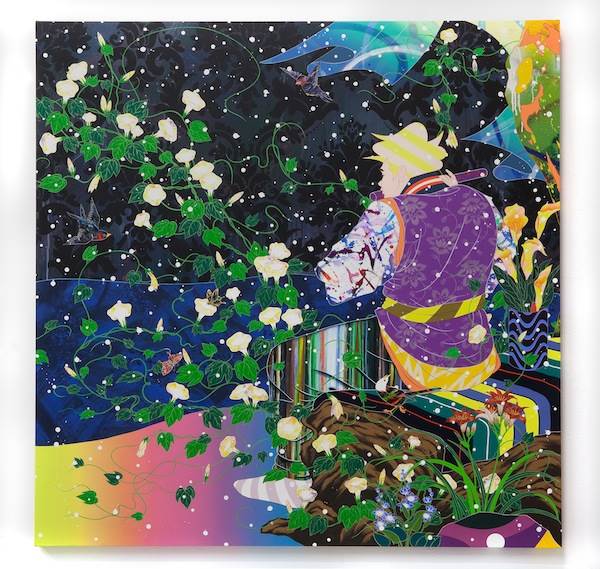
Tomokazu Matsuyama, Change Fall Over, 2017, acrylic and mixed media on canvas, 120 x 120cm. Photograph: Yojiro Imasaki
You are assisted in the studio and this has drawn comparisons to Jeff Koons or the team involved in creating a Ukiyo-e woodblock print. How do you define authorship?
While this question is compelling because you draw comparisons to Jeff Koons – who deals with authorship, especially in his earlier works – let’s compare this with the Renaissance Masters or the Kano School of classical Japanese painting. There is historical significance in almost every region around the world that deals with creating works with overwhelming amounts of detail and scale. Two hands are never enough, and that is my approach. If the question that arises is whether someone else helps paint your work, then the discussion comes down to if it’s concept-driven or craft-driven.
My work is definitely concept-driven, but has the extremity of craft attached. If viewers feel that my work is not genuine, it is up to them – but then again, that also becomes part of my work. Although I have several assistants, I don’t run a factory-based style. It takes 45-60 days to finish a painting, even if it is a very small one.
Lesley Kehoe Galleries
Until 13 October, 2017
Melbourne