In Paris in the late 1800s a favourite subject for Impressionist artists such as Claude Monet, Édouard Manet, and Gustave Caillebotte was the Pont de l’Europe. This immense bridge, built in the 1860s to span the railway tracks at Saint-Lazare Station, became a powerful symbol of late nineteenth-century Paris and an icon of the city’s modernity and industrialisation. The Impressionists presented the bridge as a homage to industry with its grand steel arches cloaked in clouds of smoke and steam from the railways. Monet was so enamoured with the bridge that he painted numerous versions of the scene.
Another artist who portrayed the bridge during this time was Édouard Vuillard in his colour lithograph On the Pont de l’Europe from the portfolio ‘Landscapes and interiors,’ 1899. Vuillard’s On the Pont de l’Europe is in the collection of the Art Gallery of South Australia (AGSA) in Adelaide and is currently on display at the gallery in Monet to Matisse: Defying Tradition. At the AGSA, Tansy Curtin, Assistant Director, Artistic & Collection Programs, says that Vuillard is an important artist at a time when artists transitioned from the French Impressionism movement to the proliferation of movements known under the broad term of Post-Impressionism. “A member of the Nabis, Vuillard and other members of the group saw themselves as prophets of modernism,” Curtin says. “In many ways the Nabis synthesised the divergent streams of Post-Impressionism, bringing together Impressionism, Symbolism, Cloisonnism, and Abstraction, which they incorporated into their own diverse artistic styles and genres. Vuillard is particularly recognised for his interest in Japanese print making and his adoption of the flattened picture plane commonly used in these prints. In the hierarchy of visual arts, we often focus on the great paintings of this period, but On the Pont de l’Europe reminds us that artists were working across a variety of media, and studying these other works offers a new or different perspective.”
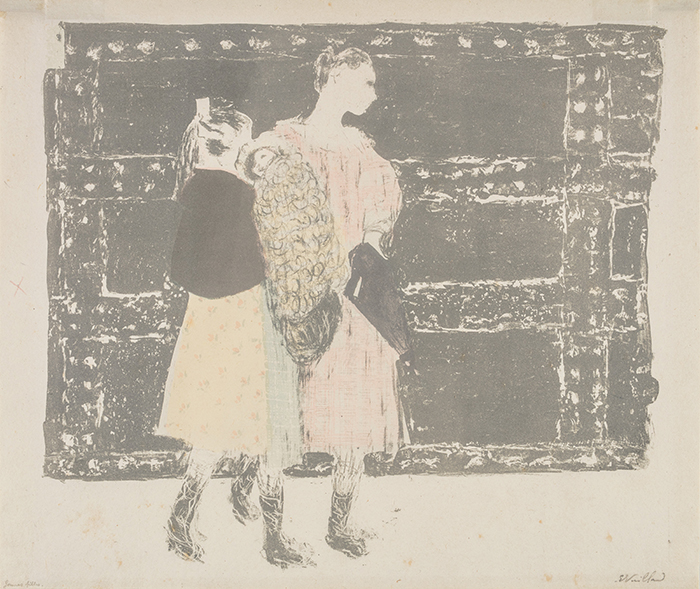
Édouard Vuillard, On the Pont de l’Europe from the portfolio ‘Landscapes and interiors,’ 1899, colour lithograph on paper, 33.1 × 39.4cm (sheet) / Collection Art Gallery of South Australia, Adelaide / David Murray Bequest Fund 1939
Vuillard’s lithograph depicts two young women, one carrying a baby, but despite the title of the work, the portrayal of Pont de l’Europe is virtually unrecognisable as a bridge. “The steel arches are entirely without depth and appear almost like background decoration and the artist has focused exclusively on the brightly dressed figures in the foreground,” Curtin explains. “The print feels entirely modern and avant garde, the way the trio appear almost pasted onto the surface seemingly rejects all the conventions of perspective at the time. I find it fascinating that Vuillard has subverted the narrative of Paris as a great industrialised centre and turned majesty into domesticity. Here the bridge is merely a mode of transit between one location and the next as this group of three go about their daily lives. The brightly coloured patterns of the women and baby’s garments offer a lovely counterpoint to the heavy black and white background. It feels as though Vuillard wants us to see there is joy and whimsy to be found in everyday life, not just the extraordinary moments.”
Bronwyn Watson has been writing about visual arts for leading newspapers and magazines for over thirty-five years.
Art Gallery of South Australia
On display in Monet to Matisse: Defying Tradition until 8 November 2026
South Australia
Originally published in print – Art Almanac, August 2026 issue, pp. 34–35