Nolan, Boyd, and Tucker – these names are intrinsic to mid-twentieth-century Australian modernism. Yet, despite leaving the country at the age of thirty-six, Sidney Nolan remains the most iconic painter of his generation. His Ned Kelly series, in particular, still resonates in the visual imagination of many Australians.
A new landmark exhibition, Nolan: Origins, explores what makes Nolan’s practice so enduring and engaging. Presenting more than 150 works from the late 1930s until his move to the UK in 1953, the exhibition focuses on his formative years. At a time when the Australian art world still looked to European traditions for inspiration, Nolan developed a new visual language that reimagined the Australian landscape, colonial history, and folklore.
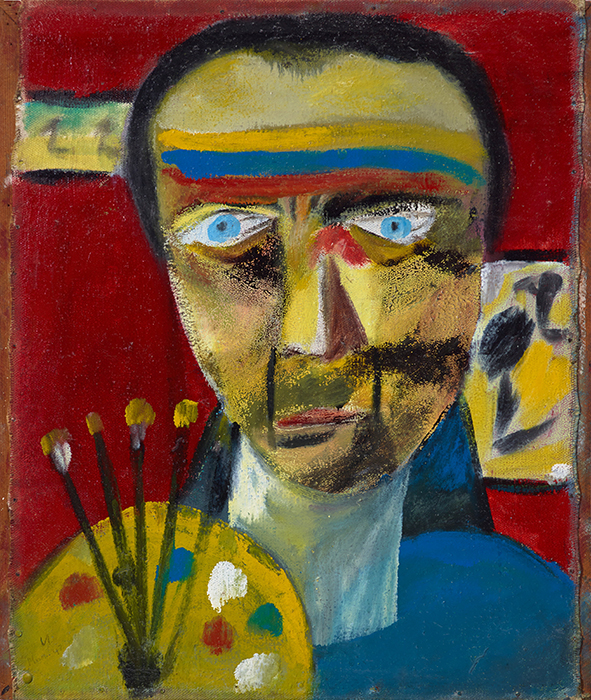
Sidney Nolan, Self portrait, 1943, Ripolin enamel on hessian sacking, 61 × 52cm / Art Gallery of New South Wales, purchased with funds provided by the Art Gallery Society of New South Wales 1997 / © The Sidney Nolan Trust, all rights reserved, DACS, Copyright Agency
Ahead of its opening on 3 October, Art Almanac spoke with curator Denise Mimmocchi, Senior Curator of Australian Art at the Art Gallery of New South Wales, about the exhibition.
The Art Gallery of New South Wales last held a Sidney Nolan retrospective in 2007. Two decades later, what fresh perspective does this new exhibition offer?
Firstly, we’re focusing on a very specific period of Nolan’s life. His career and output was vast. And this is really a close focus on those formative years of his in Australia and his deep connection with trying to find out what Australia is to him.
The other thing is that in 2026, when we’re talking about notions of Australia, of landscapes and of the country of Australia, our thinking about it is very different. For the most part, for white Australians, we are connecting, as we should, more deeply to an understanding of these notions of the country as a kind of contested ground as well.
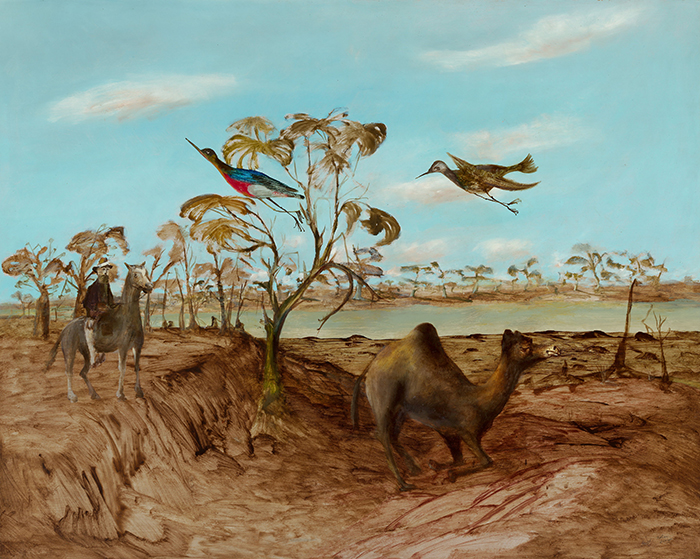
Sidney Nolan, Burke at Cooper’s Creek, 1950, oil and Ripolin enamel on hardboard, 121.5 × 152cm / National Gallery of Australia, Canberra, gift of American Friends of the National Gallery of Australia, Inc, New York, USA, made possible with the generous support of Mr and Mrs Benno Schmidt of New York and Esperance, Western Australia, 1987 / © The Sidney Nolan Trust, all rights reserved, DACS, Copyright Agency
The exhibition covers little more than a decade, yet Nolan’s practice changed dramatically. Where does that transformation begin?
We start around 1938 and that’s when Nolan as a young 20- to 21-year-old in Melbourne decides he wants to be a full-time artist. He wants to be a modern artist and an avant-garde. It starts with his early experiments, and then basically we’re looking at the period as his work developed until 1953, and that’s when he leaves Australia to live permanently in England. But it’s a hell of a ride in that decade.
How will the exhibition be presented?
The different rooms in the exhibition really relate to the different places that he is painting or creating from. We move from the works he based on St. Kilda where he grew up and lived for the first seventeen years of his life; his memories of that childhood. We have a very important section on the Wimmera, where he was stationed during the war when he was conscripted into the army guarding food stores out there.
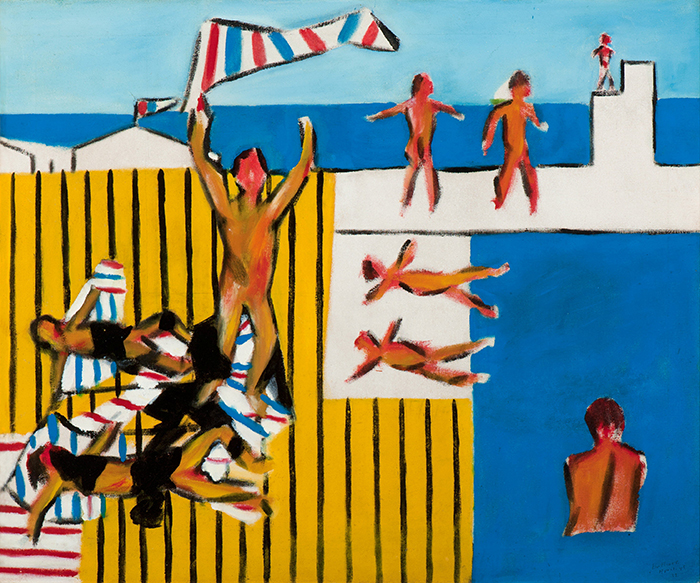
Sidney Nolan, Bathers, 1943, Ripolin enamel on canvas, 62.9 × 75.5cm / Heide Museum of Modern Art, Melbourne, bequest of John and Sunday Reed 1982 / © The Sidney Nolan Trust, all rights reserved, DACS, Copyright Agency
For many, a highlight of the exhibition will be the Ned Kelly series, which of course is very important in these years. But again, it’s of course about the story of Kelly and the outlaw and how that played on his own imagination. But it’s also, as Nolan said himself, a story that begins and ends in the bush. So it’s the landscapes around Glenrowan and Northeast Victoria, which he visited and knew, that are important to the making of that series as well.
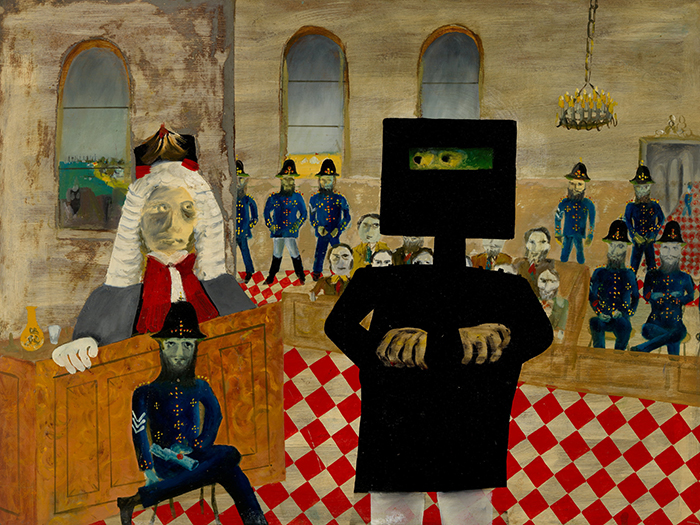
Sidney Nolan, The trial, 1947, Ripolin enamel on hardboard, 90.7 × 121.2cm / National Gallery of Australia, Canberra, gift of Sunday Reed 1976 / © The Sidney Nolan Trust, all rights reserved, DACS, Copyright Agency
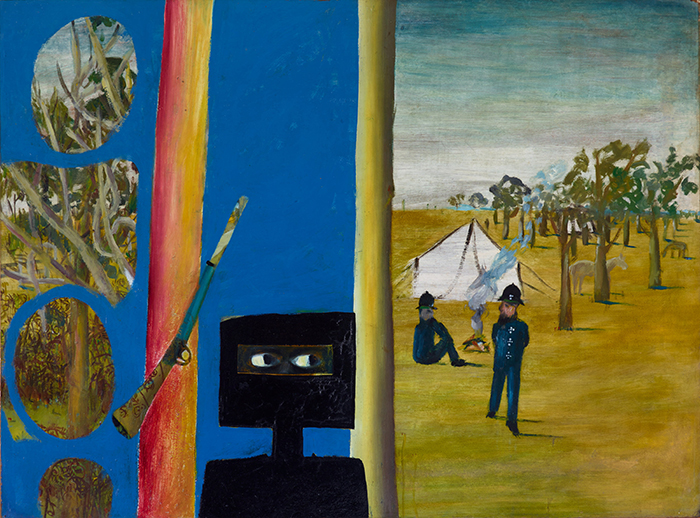
Sidney Nolan, The camp, 1946, Ripolin enamel and alkyd on hardboard, 89.7 × 121.5cm / Art Gallery of New South Wales, purchased 1978 / © The Sidney Nolan Trust, all rights reserved, DACS, Copyright Agency
And then moving on, we have a section on K’gari or Fraser Island as it was known to Nolan, where he travels after the war. And then of course the wonderful series of works that he created from his travels throughout Western Queensland and then Central Australia, which are really kind of climactic in his practice in Australia.
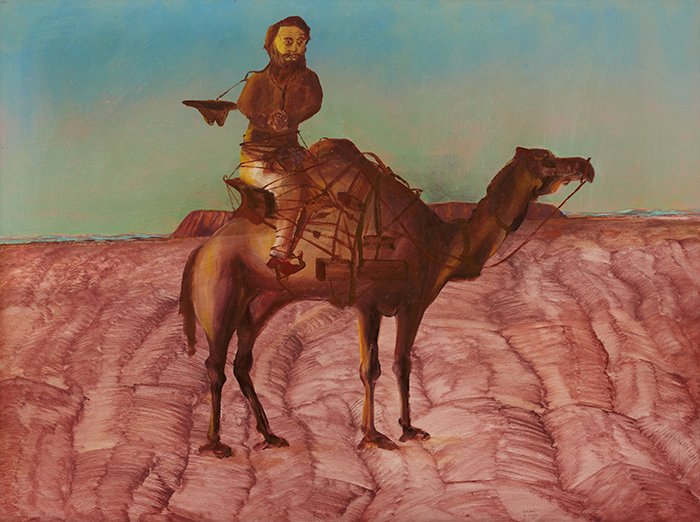
Sidney Nolan, Burke and Wills expedition, “Gray sick”, 1949, Ripolin enamel and oil-based red ochre on hardboard, 91.5 × 121.5 cm / Art Gallery of New South Wales, gift of Edron Pty Ltd 1995 through the auspices of Alistair McAlpine / © The Sidney Nolan Trust, all rights reserved, DACS, Copyright Agency
His Central Australian works, made in response to drought, also feel remarkably contemporary. Why?
He was commissioned by a newspaper to go and create a series of drawings based on the effects of a devastating drought throughout Western Queensland and into the Northern Territory. And his initial works were a series of drawings, but he then developed them into these extremely eerie paintings of these carcasses of cattle.
There is a surreal quality to them. Having said that, they are images that we unfortunately have become more familiar with. It’s interesting in that sense that as our climate situation intensifies and becomes increasingly disastrous, that these works that for Nolan signalled something terrible and traumatic in the landscape have become a very unwelcome reality for many of us.
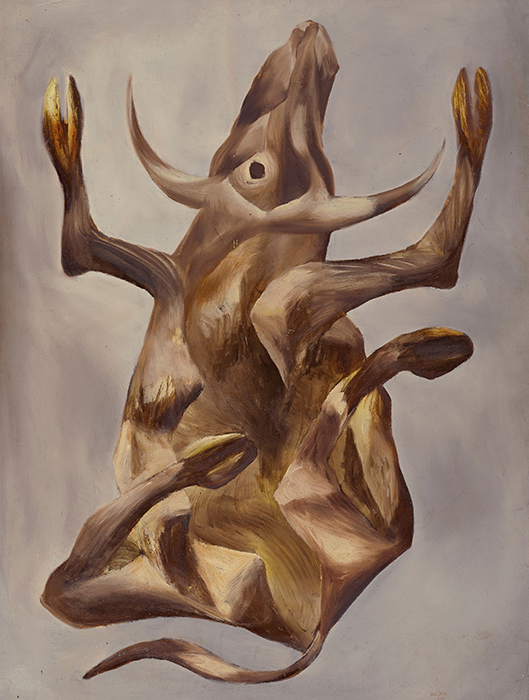
Sidney Nolan, Carcase, 1953, oil and Ripolin enamel on hardboard, 120.8 × 91.4cm / Private collection / © The Sidney Nolan Trust, all rights reserved, DACS, Copyright Agency
What do you hope audiences, particularly younger audiences, will gain from the exhibition?
For those who might not be as familiar with Nolan’s work, I hope that it gives a sense of the incredible creative array of his work from these years. For people who do know his work quite well coming back to see, again, the breadth of his practice and showcasing it in this one exhibition from this concentrated period within his career, I hope that sort of highlights, again, the astounding diversity of his work and his questioning of this place where he was living and grew up in and experiencing during the 1940s and early ’50s.
It’s looking too at a sense of Australia as this rich creative terrain and platform from which to invent this incredible artwork from.
Victoria Hynes is a visual arts writer and editor based in Sydney.
Art Gallery of New South Wales
3 October 2026 to 7 February 2027
Sydney
Originally published in print – Art Almanac, October 2026 issue, pp. 18–27