“. . . shaping the visual imaginations of their respective nations . . .”
National Gallery of Australia curator Anne O’Hehir’s vision was to explore remarkable parallels between two most influential photographers. With generous support from the Bowness Family Foundation, a two-year travelling exhibition is now presenting works by the two master photographers – Australian Max Dupain (1911–92) and American Ansel Adams (1902–84) – together in a worldwide first, exclusively for Australian regional communities.
Max Dupain and Ansel Adams: in search of perfection firstly explores the early creations of these two famous photographers then emphatically focusses on their later works. Their images were created using uncannily similar methods.
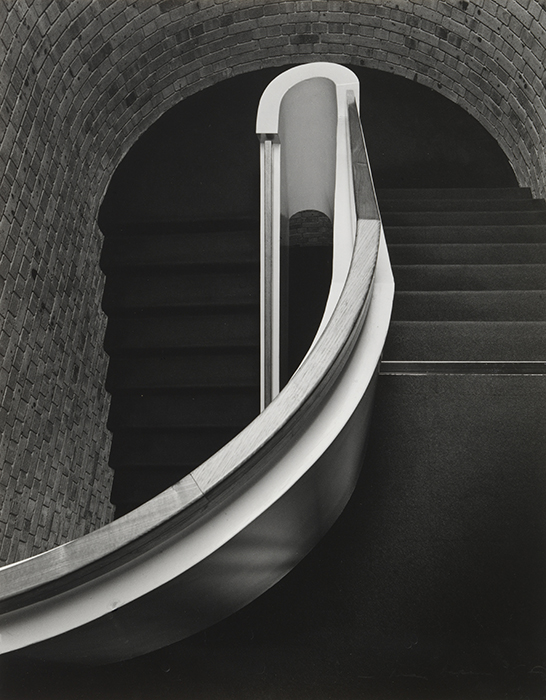
Max Dupain, Stair rail, 1975 / National Gallery of Australia, Kamberri Canberra, purchased 1983 / © Max Dupain/Copyright Agency 2026
Dupain’s assistant, Eric Sierins, has said that Dupain felt Adams spent too much time altogether planning the technical side of his photography, therefore producing cold results with no element of risk. However, from the 1950s, Dupain’s approach, in his almost four decades collaborative practice with architect Harry Seidler – a leading exponent of Modernism’s methodology – showed similar planning.
While Adams is most noted for landscape images of the American West, both photographers were shaping the visual imaginations of their respective nations, creating works that continue to resonate with audiences – using Modernist photography that challenged the art world’s ‘definition’ of art. Dupain’s own oft-quoted words were: “Modern photography must do more than entertain, it must incite thought and by its clear statements of actuality, cultivate a sympathetic understanding of men and women and the life they live and create.”

Ansel Adams, Moon and Half Dome, Yosemite National Park, California, 1960 prtd 1980 / National Gallery of Australia, Kamberri Canberra, purchased 1980 / © The Ansel Adams Publishing Rights Trust
The significance of this tour, which has a regional emphasis, is that it seeks to provide Australian communities with access to some of the most emblematic photographs of the twentieth century and, by doing so, increase their understanding of photography’s enormous cultural impact in Australia. Photography is key for telling stories, using pictures to show significant things. Dupain’s Sunbaker, c.1938 is symbolic of Australia’s (and, probably, America’s) beach culture. Adams’ Moon and Half Dome, Yosemite National Park, California, 1960 likewise is a great example of the many magnificent landscapes to be found in both countries.

Max Dupain, City lights, 1939 / National Gallery of Australia, Kamberri Canberra, purchased 1983
At the Ansel Adams Gallery in the heart of the Yosemite Valley, with its great views of Adams’ favourite landscapes, I became familiar with his oft quoted: “I go out into the world with my camera and come across something that excites me emotionally, spiritually, or aesthetically. I see the image in my mind’s eye. I make the photograph and print it as the equivalent of what I saw and felt.” That also very much describes Dupain’s approach to his architectural works.
Including sixty-three works, the show allows visitors to compare the masters’ landscapes and also some by others – such as Harold Cazneau’s Folded Hills, 1937 and Annie W. Brigman’s Sanctuary – The Grand Canyon, 1921. Likewise, portraits made by the two artists can be seen, together with Dorothea Lange’s From Minnesota to be resettled in the Matanuska Colony in Alaska, 1935 and David Moore’s Surry Hills Boy 1, 1948. And Dupain’s Modern Chord, 1934 is there to be seen along with Olive Cotton’s Cones, c.1938.

Ansel Adams, Surf Sequence – four, San Mateo County Coast, California, c.1940 prtd 1981 / National Gallery of Australia, Kamberri Canberra, purchased 1980
Both Dupain and Adams were adamant about working in black and white and placing an emphasis on control, proportion, and structure. Both previsualised their images and were determined that prints made from them absolutely showed reality. They each used sharp focus, high contrast, and rich tonality to faithfully reproduce that reality.
Brian Rope OAM has been president of the Australian Photographic Society twice, and is an active member of the Canberra Critics Circle Visual Arts Group.
Bayside Gallery
20 June to 30 August 2026
Melbourne
Logan Art Gallery
30 January to 3 April 2027
Queensland
Originally published in print – Art Almanac, June 2026 issue, pp. 18–22