

How has the story of the Garden Palace inspired the project?
When I first went looking for cultural material from where my family is from I found that it, like a lot of other material from south-east communities, was destroyed in the Garden Palace fire of 1882. Ever since I’ve been struck with a certain loss. What does that loss mean for our communities? I’m interested in how a culture can move forward when it’s unable to point to its heritage in museums.
Throughout my work and research on the project the Garden Palace has become a symbol for the repercussions of forgetting. Many people I’ve spoken to about the project hadn’t known the history of this enormous building that once dominated Sydney’s skyline both physically and conceptually. I’ve begun to question what else we can forget as a community, if something so grand and visible has disappeared from our vision.
What does the title of the project mean to you?
The name ‘barrangal dyara’ is taken from the local Sydney Language, barrangal meaning ‘skin’ and dyara, ‘bones’. Working with this language links the project to the local Sydney knowledge system. It also honours the relationship my projects have with Gadigal elders such as Uncle Charles (Chicka) Madden and Uncle Allen Madden.
barrangal dyara peels back the ‘skin’ of the site to reveal the ‘bones’ of the Garden Palace. Citing the seminal Judy Watson 1997 print series our bones in your collections, our hair in your collections and our skin in your collections, the title refers to the practice of collecting Aboriginal objects and displaying them as part of ethnological collections, as well as our connection to country. Embedded within the landscape are our ancestors, our past. And, like the Garden Palace, their skin and bones now make up country.
You’ve been collecting knowledge from so many incredible thinkers – how have people like Bruce Pascoe influenced the project?
The project has been deeply inspired by Uncle Bruce Pascoe and the work he’s been doing on early explorers. Bruce reads historical texts with fresh eyes and starts to see things that others haven’t. There’s a common belief that Aboriginal people just politely touched the ground without leaving a footprint. That’s such a romantic idea when in fact Aboriginal people were engaging with science, architecture and agriculture in very sophisticated ways. These kinds of ideas are often difficult even for our own community to come to terms with.
Aboriginal agriculture stands in absolute opposition to the story told by the Garden Palace. For the ideas represented in that building to be successful, they needed to supress the idea of Aboriginal engagement with the land. The whole fabrication of Australia’s myth, terra nullius, is underpinned by the bravado of the Garden Palace.
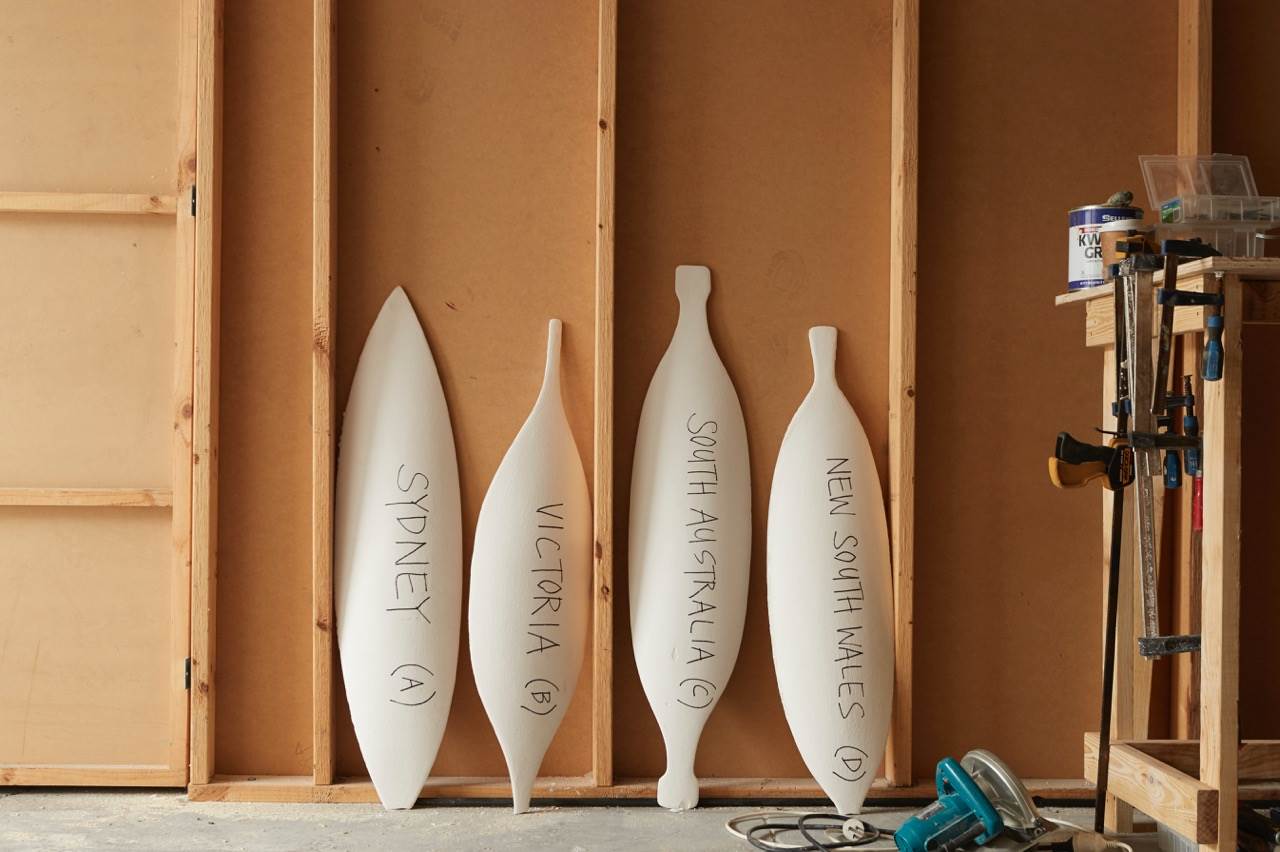
Your research into broad shields is strongly connected to the project – we’ll have 15,000 blank white shields demarcating the footprint of the Garden Palace as the major sculptural element of the project. What are the broader cultural uses of these objects?
I’ve been lucky enough to work with Carol Cooper in the museum sector, but also with community to reclaim lost objects. Most objects in museums are by unknown artists and no one knows where they’re from.
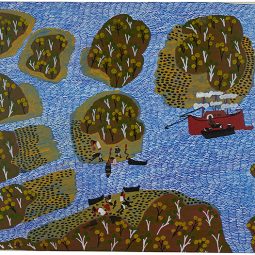
It’s important to think about the place these objects would have occupied in communities. When you look at the investment that’s gone into making them you realise that they’re highly valuable objects. They are beautifully detailed; elegantly carved with minute details inscribed into them, not something that was made quickly. We’ve been looking at the idea that they occupied a significant role in ceremony and recording cultural knowledge. One of the key places we see this represented, is in the work of Tommy McRae from the 1800s – he always depicts ceremonies, men singing and performing with their shields. I would argue that these objects function in an ‘art world’ context that we can recognise today.
When people performed for ceremony the front of the shield would have been caked up in white and/or red ochre. I’m interested by this act of covering and concealing the personal designs. That’s one of the reasons we’ve looked at making these shields plain white. In one way we’re talking about the loss of identity, but there’s two sides of the coin – they’re also blank, ready to formulate a new identity.
How has learning your language influenced the work?
It’s the philosophy behind it, the world view that’s embedded in language that I find really interesting. The Wiradjuri word for ‘fire’ is wiiny, which gets shifted into meaning ‘thinking’ and ‘enlightening your mind’ by the word winnya. This connection between fire and thinking is entrenched today, despite the absence of fire in modern city living.
Knowledge of Wiradjuri language was, until recently, down to a handful of speakers. For someone like Uncle Stan Grant Snr to turn it around in his lifetime is incredible – it’s now being taught in schools, kindergartens, universities. People like Uncle Stan prove to you that nothing’s lost – it’s all there, like an antidote to the Garden Palace.
Royal Botanic Garden
17 September to 3 October, 2016
Sydney