“. . . an imprint, an echo, and a silhouette . . .”
“I AM is an exhibition about identity and personhood,” explained Carly Lane, Curator of Indigenous Art at The Art Gallery of Western Australia. “That’s how we know ourselves, how we make sense of the world around us, and how we navigate the two is the overarching theme of the show.
“Person-centred, the exhibition brings together the art of many expressive, inquiring minds,” she continued. “In a way, these works are an imprint, an echo, and a silhouette of the artist.”
Themes woven into the exhibition of more than sixty works include connection to Country, culture, history and lived experience.
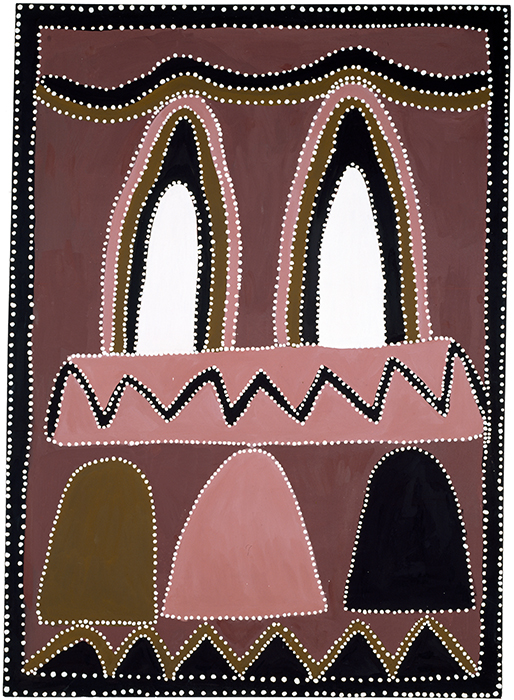
Queenie (Garagarag) McKenzie, Banana Springs, 1996, ochre on canvas, 140 × 100.5cm (sight) / The State Art Collection, The Art Gallery of Western Australia, Purchased 1996 / © Queenie (Garagarag) McKenzie, 1996 / Photograph: Bo Wong / Courtesy The Art Gallery of Western Australia, Western Australia
Dominated by artists from the West, Lane has still managed to include eighteen artists from as far afield as Mornington Island in the Gulf of Carpentaria – the great Sally Gabori; several from the Tiwi Islands; a powerful group of Yolŋu from Arnhemland; and urban leaders such as Danie Mellor, Gordon Bennett, Lin Onus, and Fiona Foley. But would any First Nations show be complete without Emily Kame Kngwarreye?
Kngwarreye, of course, raises questions about the curatorial concept of ‘personhood.’ For many, her brilliant dotting speaks of the plants and sands of her Utopia homeland. But the Kame in her name is the pencil yam – so all her works featuring yam roots and body paint lines are as much about herself as about landscape and culture.

Christopher Pease, Nyoongar Dreaming, 1999, oil on canvas, 114.2 × 147.4cm / The State Art Collection, The Art Gallery of Western Australia, Purchased 2001 / © Christopher Pease, 1999 / Photograph: Bo Wong / Courtesy the artist and The Art Gallery of Western Australia, Western Australia
And bark paintings by Wandjuk Marika, Mawalan Marika, and Narritjin Maymuru which tell creation stories are very much about where the artists come from in Yolŋu society, where it’s vital to know your origins so that you can relate to the rest of the community.
Some of the barks and Tiwi Pukumani poles date back to the remarkable Frank Norton
Collection at AGWA, put together in the 1970s when few other institutions were recognising such works as art.
But the other collection recognised in I AM is that of the COVID-19 Stimulus artists.
Presciently, AGWA negotiated a $1.5 million Stimulus Package providing direct support to
WA artists. AGWA Director Colin Walker recalled: “Our goal was to support WA artists represented in the Collection, as well as independent artists and artists in remote communities struggling during COVID-19. In total more than 400 Western Australian artists directly benefited from the initiative.”
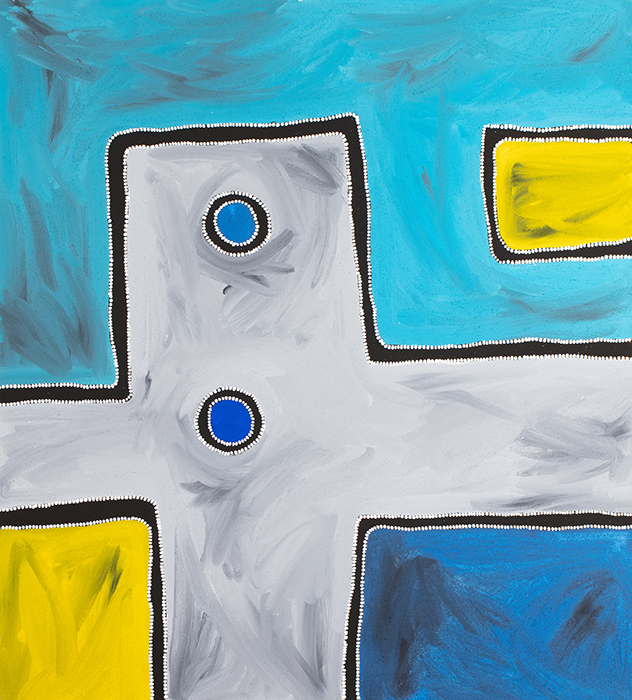
R. Ramsey, Warlawoon country, 2008, natural ochre and pigment on canvas, 135 × 122cm / The State Art Collection, The Art Gallery of Western Australia, Purchased through The Art Gallery of Western Australia Foundation: COVID-19 Arts Stimulus Package, 2020 / © R. Ramsey, 2008 / Photograph: Bo Wong / Courtesy The Art Gallery of Western Australia, Western Australia
On show from this group will be Judith Yinyika Chambers, Sharyn Egan, Peter Farmer Jnr, Dallas Fletcher, Rohin (Dushong) Kickett, Mrs Kurarra, Kittey Ngyalgarri Malarvie, Laurel Nannup, R. Ramsey, Leah Umbagai, and master of the Wandjina, D. Woolagoodja.
In all, there will be eleven Noongar artists from southern WA included, with new acquisitions by Bella Kelly, one of the renowned Carrolup School of child artists in the ’40s and ’50s, and Christopher Pease, whose works engage with Noongar Country through political themes.
Almost personifying ‘personhood,’ another local is Julie Dowling whose iconic portraits and mental maps of family record the deep-seated injustices she perceives in the Indigenous community.
I AM will run for eighteen months from the end of February 2026, with two major rotations introducing new works in August 2026 and again in early 2027, ensuring the exhibition continues to evolve and offer fresh perspectives.
Jeremy Eccles is a specialist arts commentator with a long-term engagement with First Nations culture.
The Art Gallery of Western Australia
28 February 2026 to 2027
Western Australia
Originally published in print – Art Almanac, April 2026 issue, pp. 22–25