“Ken Tyler taught us to dream big . . .”
Ken Tyler is a man of modest physical stature who, when it came to printmaking, dared to dream big. With his simple philosophy that it takes great artists to make great prints, he set out to seduce some of the biggest names in the American art scene to make prints with him. He told his potential artist collaborators to think big and whatever they could dream of, the answer was ‘yes it can be done’. At times this involved building printing presses on a scale that had previously been unimagined, making special huge sheets of paper, using materials that had never been employed in printmaking before and inventing techniques that would have been unimaginable a few years earlier.

Roy Lichtenstein, Tyler Graphics (printer and publisher), Reflections on Crash, 1990, from the ‘Reflections’ series
National Gallery of Australia, Kamberri/Canberra, purchased 1991
© Estate of Roy Lichtenstein/Copyright Agency 2025
Courtesy National Gallery of Australia, Australian Capital Territory
The result was that Tyler spearheaded a renaissance in American printmaking in the second half of the twentieth century making breathtakingly huge prints by some of the biggest names in art. The Tyler legacy lasted almost five decades and redefined what was possible in printmaking.
The National Gallery of Australia, under its inaugural director James Mollison, in 1973 acquired a huge collection of printer’s proofs and subsequently kept on acquiring additional material through purchase and gift to make it the largest archive of Tyler material internationally. It consists of over 7,400 editioned prints, proofs, drawings, paper works, screens, multiples and illustrated books as well as a collection of rare candid photography, film and audio. Tyler has showered the gallery with donations and funding for curatorial staff, exhibitions and publications.
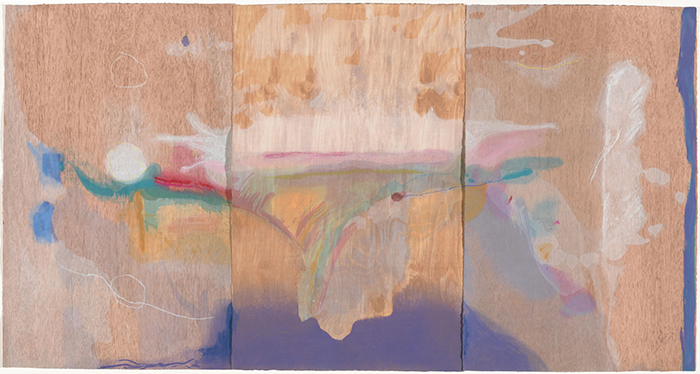
Helen Frankenthaler, Tyler Graphics (printer and publisher), Madame Butterfly, 2000
National Gallery of Australia, Kamberri/Canberra, purchased with the assistance of the Orde Poynton Fund 2002
© Helen Frankenthaler / Tyler Graphics Ltd. 2000
Courtesy National Gallery of Australia, Australian Capital Territory
Proofs and Processes: The Kenneth Tyler Collection exhibition consists of two aspects. The first is the exhibition itself, consisting of the work of six icons of Abstraction and Pop art. They are Helen Frankenthaler, Roy Lichtenstein, Joan Mitchell, Robert Motherwell, James Rosenquist, and Frank Stella, all of whom worked with Tyler Graphics from 1986 to 2001 at the Mount Kisco premises in New York state.
While many of these works have featured in exhibitions at the gallery before, it is still breathtaking to see Helen Frankenthaler’s Madame Butterfly, 2000 – a 102 colour woodcut from forty-six woodblocks. Over two metres in length, it is exhibited together with its matrices. I remember crying when I first saw it and over the years it has lost none of its hypnotic power. Lichtenstein’s Pop art graphics have become icons for a generation and the Frank Stella abstractions and Robert Motherwell’s elegies have become some of the defining images in American art.

Joan Mitchell, Tyler Graphics (printer and publisher), Weeds I, 1992
National Gallery of Australia, Kamberri/Canberra, purchased with the assistance of the Orde Poynton Fund 2002
© Estate of Joan Mitchell
Courtesy National Gallery of Australia, Australian Capital Territory
The second aspect is the Tyler book. In any way you put it, it will be an understatement. It is a huge three volume publication cataloguing some 1,040 works by twenty-eight artists printed by Tyler between 1986 and 2001. It leads on from the publication of the Tyler Graphics, catalogue raisonné 1974–1985, published by the Walker Art Center in Minneapolis. The NGA publication, Tyler Graphics, catalogue raisonné 1986–2001, edited by Dr Jane Kinsman, physically is the most impressive publication on printmaking to be published in Australia.
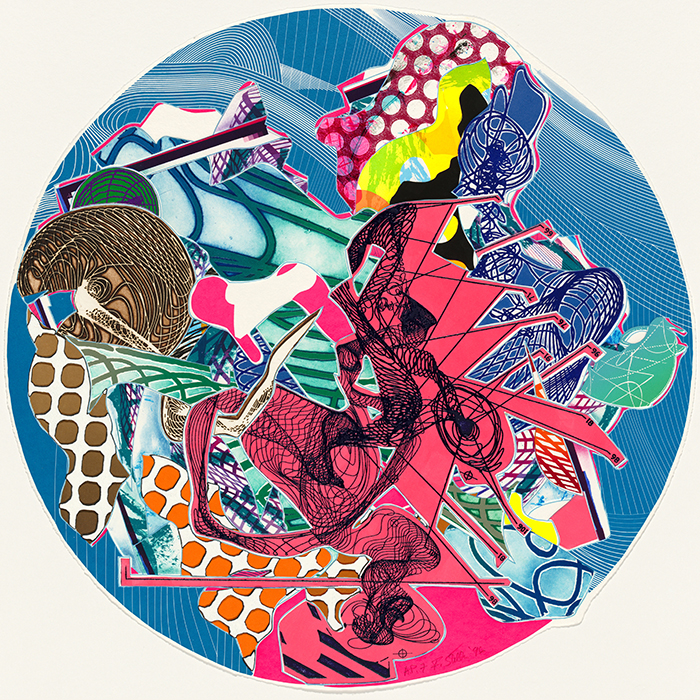
Frank Stella, Tyler Graphics (printer and publisher), Perinthia, 1996, from the ‘Imaginary places II’ series
National Gallery of Australia, Kamberri/Canberra, purchased with the assistance of the Orde Poynton Fund 2002
© Frank Stella. ARS/Copyright Agency
Courtesy National Gallery of Australia, Australian Capital Territory
The scholarship is meticulous, the documentation is comprehensive, and it is exhaustively illustrated. While it may appeal to a dedicated audience, features like the updated Tyler glossary of printmaking terms (over forty pages) and the scholarly contextual essays broaden its usefulness.
Ken Tyler taught us to dream big – the NGA adds to this dream.
Emeritus Professor Sasha Grishin AM, FAHA works nationally and internationally as an art historian, art critic and curator.
National Gallery of Australia
19 July 2025 to 2 August 2026
Australian Capital Territory
Originally published in print – Art Almanac, March 2026 issue, pp. 26–29