“. . . a quiet urgency to protect . . .”
There are two things, other than family, that have sustained landscape painter Jane Tonks – time spent in nature, and time spent making art. “From a very young age, I knew that I was an artist,” says Tonks. “I was always drawn to landscape painting because I felt an innate need to be nurtured by the land. If I haven’t been in nature for a few weeks, I feel on edge. I need to be connected to nature for my wellbeing.”
Even before the Japanese practice of shinrin-yoku (forest bathing) became popularised, Tonks often spent time immersed in the bushland surrounding Orange, where she grew up and continues to live. Nature | Nurture, Tonks’ solo exhibition curated by Belinda Hungerford, captures small pockets of surviving sub-alpine bushland on Gaanha-bula (Mount Canobolas), a volcanic mountain just outside Orange surrounded by farming land and pine logging forests.
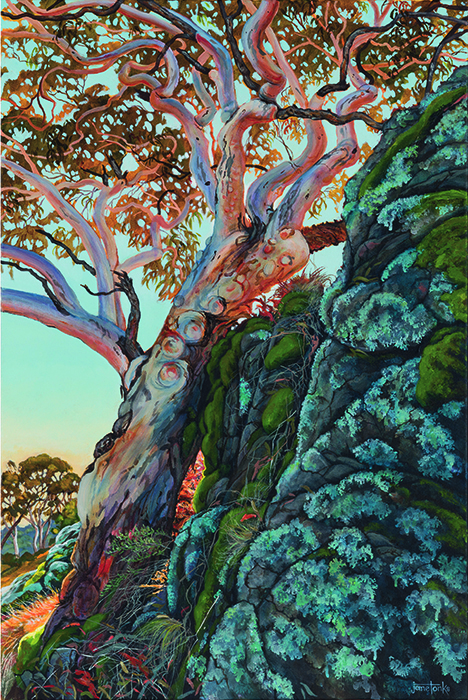
In the presence of the Elder (Mt. Towac), 2025, acrylic on polycotton, 93 × 63cm
Courtesy the artist and Orange Regional Gallery, New South Wales
Over time, Tonks’ landscapes have evolved into a practice in environmental activism, their beauty instilling a quiet urgency to protect these precious places which may soon be lost. After the fire (Gaanha-bula), 2018 is the most direct depiction of climate devastation. A large gumtree, likely many centuries old, has succumbed to drought following the stress of the 2018 bushfires. For Tonks, gumtrees are symbolic of resilience and wisdom, especially those growing atop Gaanha-bula that are prone to heavy snowfalls, strong winds, drought and fires. “These trees are quiet witnesses to the history of this place and the history of culture,” says Tonks. “How many winters, how many fires and droughts did this tree endure, until climate extremes pushed it over the edge?”
Other works are more subtle, scatterings of charred tree trunks a reminder of the accelerating impact of human-induced climate change. A triptych, Wiradjuri Country vista from Mt. Towac, 2025, draws us into idyllic scenes of a seemingly untouched landscape. Telecommunications towers in the far distance are a motif of the omnipresence of human intervention in the landscape.

Forest Giant, reaching for the heavens (Nature loop track), 2025, acrylic on polycotton, 63 × 43cm
Courtesy the artist and Orange Regional Gallery, New South Wales
Tonks’ compositions take on an atmospheric, magical quality, capturing the relief of a cool mist drifting over the mountains, or the golden warmth of dappled sunlight through a canopy of gumtrees. Tonks walks with binoculars, a camera and sketch materials, returning to her studio to capture the energy of the place. “When I’m in the flow, I feel like it’s not me painting,” says Tonks. “I get taken over, I’m an instrument for this beautiful connection with nature to flow through me. I’ve got to feel the energy of a place. If I can’t feel it, I can’t paint it.”

Spinning around the sun (IV) – Spring (Gaanha-bula), 2025, acrylic on polycotton, 79 × 79cm
Courtesy the artist and Orange Regional Gallery, New South Wales
Nature | Nurture is a call to action. Tonks compels us to care. “Nature nurtures us, but we must nurture nature in return. Is it instinctual? Is it in our nature to nurture?” ponders Tonks. “If you don’t have access to forests or green spaces, you might feel disconnected. We need to reconnect people for them to care, to start thinking about their own relationship to the environment. I hope that I send out a ripple of nurture to each individual who sees this exhibition, so that they might start nurturing nature in whatever way they can.”
Sophia Halloway is an art critic and writer based in Kamberri/Canberra.
Orange Regional Gallery
7 February to 29 March 2026
New South Wales
Originally published in print – Art Almanac, March 2026 issue, pp. 22–25