“. . . back to revisit and rework . . .”
There are experiences in life that shape a person’s outlook in lasting ways. For painter William Mackinnon, that defining period came in the two transformative years he spent living and working with the Kintore and Kiwirrkurra Indigenous communities of Central and Western Australia in 2008. During this time, he found his previous Western art training was “blown apart.” Until then, his career had been grounded in a European context: internships in Venice and Texas, work as a studio assistant across Melbourne, the UK, and France, study at Chelsea Art School in London, and a Master’s degree at the Victorian College of the Arts. Finally, he felt compelled to explore his own country.
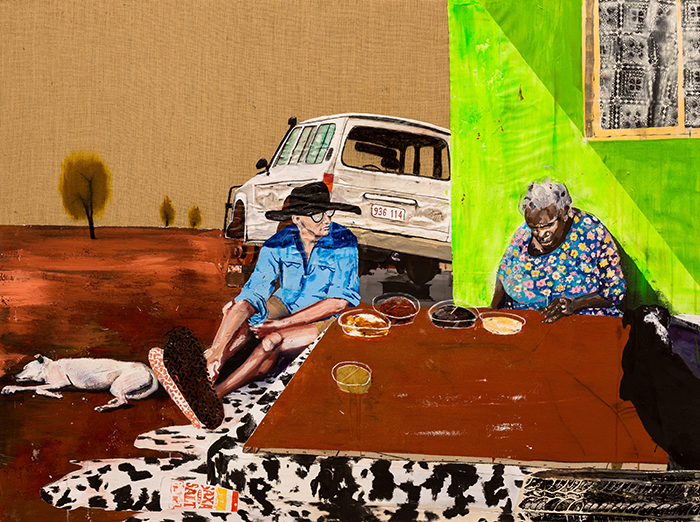
Sitting with Naata Nungurayi, 2019, acrylic, oil and automotive enamel on canvas, 150 × 200cm / Courtesy the artist and Museum and Art Gallery of the Northern Territory, Northern Territory
Living in remote communities proved both confronting and transformative. Mackinnon began painting as a way to understand and process the isolation of desert life, and it was here that he discovered his own artistic vision. He describes the world he encountered after Europe as “an alternative cultural canon.” Now dividing his time between the Victorian south coast and the Spanish island of Ibiza, the artist is renowned for his striking psychological landscapes featuring winding roads, vacant homes, cars, and road signs. Yet the intensity of his time in the Northern Territory and the Kimberley drew him back to revisit and rework earlier “in situ” paintings, deepening them through the perspective of a more mature artist.
This subsequent body of work, titled Phoenix, re-examines his creative formation. Reflecting on this period, Mackinnon states: “These experiences left indelible marks and lessons that shaped me as a person and an artist.”
Completed between 2019 and 2025, the series draws on his familiar iconography – graffitied road signs, rusted cars, and wheelless caravans. Hooded figures fronting derelict fibro houses cast long shadows across the terracotta earth; a local football match takes place around an overturned abandoned vehicle. These compositions refine and expand on the paintings executed more than a decade earlier, dramatising them through saturated colour and deep shadows.
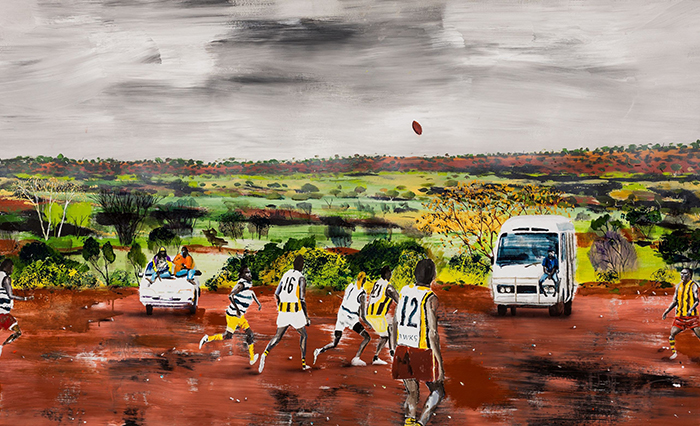
Kiwirrkurra Blues, 2019, acrylic, oil and automotive enamel on canvas, 150 × 200cm / Courtesy the artist and Museum and Art Gallery of the Northern Territory, Northern Territory
The earlier painting Community, 2010 evolves into Our Secret History, 2019, incorporating new materials such as automotive enamel and glitter. The scenes often resemble staged film sets, with theatrical lighting and moody skies that evoke a sense of displacement and dislocation. Yet they also include everyday details – camp dogs, washing lines, footy players, and artist elders – suggesting a tenacity in spite of the social challenges that plague desert communities.
Mackinnon comments that: “These works are very loaded and charged, there is melancholy and also levity and everything in between. They are formally inventive, playful . . . words cannot simulate their emotional range, the contradictions and power and complexity of everything that is to be experienced in viewing the painting . . .”
Across the series, Mackinnon experiments boldly with technique. In Burke and Wills, 2019, termite mounds are formed by sanding layers of modelling paste, while surfaces incorporate liquid nails, charcoal washes, and collaged canvas. Elsewhere, he uses peeled acrylic paint skins, shoe imprints, and tyre marks.
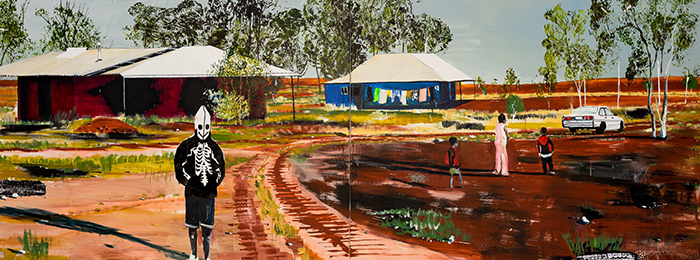
The purple house, 2019, acrylic, oil and automotive enamel on canvas, 150 × 300cm / Courtesy the artist and Museum and Art Gallery of the Northern Territory, Northern Territory
Displayed alongside their earlier iterations, these sixteen large-scale paintings trace both an artistic and personal journey. Together, they reveal a process of creative upheaval that led to a new confident trajectory for the painter.
Ultimately, William Mackinnon describes the exhibition as: “a warts and all celebration of resilience, humour, and adaptability in adversity filled with beauty, sport, art, and life.”
At its core, his practice always remains driven by his simple aim: to describe “what it feels like to be alive in the world.”
Victoria Hynes is a visual arts writer and editor based in Sydney.
Museum and Art Gallery of the Northern Territory
21 February to 24 May 2026
Northern Territory
Originally published in print – Art Almanac, May 2026 issue, pp. 29–32