Celebrating St. Francis’s humanity
When Arthur Boyd died in 1999, he had never seen the twenty huge tapestries of his St. Francis legend exhibited in a gallery. In fact, no one has. Apart from twelve of them being shown in Adelaide in 2023, they have remained somewhat of a mystery.
Arthur Boyd belonged to Australia’s most famous art dynasty. His grandparents, Emma Minnie Boyd and Arthur Merric Boyd were professional artists, his parents, Merric Boyd was a pioneering studio potter and his mother Doris was a painter, his uncle, Penleigh Boyd was a prominent painter and uncle Martin Boyd was a well-known writer. All of his siblings were engaged in the arts.
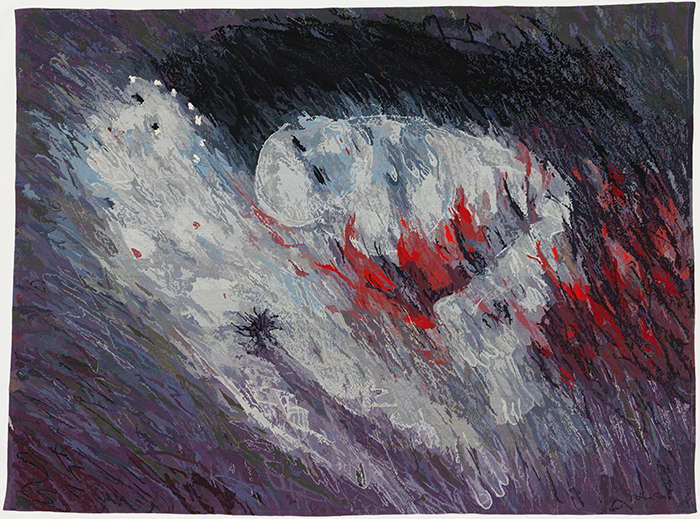
Arthur Boyd, Manufactura de Tapeçarias de Portalegre (tapestry workshop), St Francis lying in the flames, 1972 / National Gallery of Australia, Kamberri Canberra, purchased 1975 / Arthur Boyd’s works reproduced with the permission of Bundanon Trust
The family home in Murrumbeena, on the outskirts of Melbourne, was like an artist’s colony, where the deeply religious Merric was the reigning patriarch and where Biblical narrative and reality frequently merged. It was here that Arthur Boyd was first attracted to the theme of St. Francis. In 1959, Boyd participated in the Antipodean Manifesto exhibition, his father died and he emigrated to England. In London, he found considerable success and his preoccupation with the St. Francis legend grew and he visited Assisi and Gubbio in Italy, places central to the life of St. Francis. In 1965, he exhibited a series of pastel drawings on the theme of St. Francis at Australian Galleries in Melbourne and although the exhibition passed quietly, without attracting sales, Boyd had large colour transparencies made from twenty of these drawings.
At considerable cost, Boyd commissioned the Manufactura de Tapeçarias de Portalegre, in Portugal, to weave twenty huge tapestries, each about two-and-a-half metres by almost three-and-a-half metres. This was done between 1972 and ’74 and the following year, inaugural director of the National Gallery of Australia, James Mollison, bought them for the national collection. The gallery itself was not to open for another seven years and the tapestries remained in storage for the next half century until they have been gloriously displayed, for the first time all twenty of them, accompanied by many of the pastel drawings, the colour transparencies, and other St. Francis-related material including the superb black and white lithographs. The Senior Curator of Australian Art at the NGA, Elspeth Pitt, needs to be congratulated on a superb exhibition and catalogue.
The exhibition is a revelation on many levels. As tapestries, they are a curious hybrid creation and unlike the modern understanding of tapestry as a creative collaboration between the weavers and the artist. The Portuguese weavers set out to produce a very fine facsimile copy of Boyd’s drawings, but on a huge scale, with a density of 2,500 stitches per square metre. Even more curiously, they are copies of the transparencies, rather than of the drawings themselves, as becomes apparent in the interpretation of some of the colours.
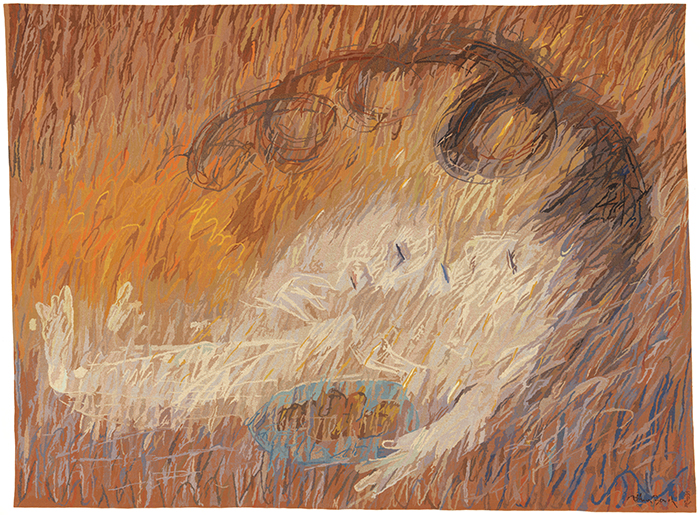
Arthur Boyd, Manufactura de Tapeçarias de Portalegre (tapestry workshop), St Clare attending to St Francis, 1974 / National Gallery of Australia, Kamberri Canberra / Arthur Boyd’s work reproduced with the permission of Bundanon Trust
The other revelation is Boyd’s imagery. He was not interested in relating the St. Francis story with the saint preaching to the birds, but he presents ‘moments’ in the life of the saint in powerful detail. For example, the encounter with a leper, taming of the wolf of Gubbio, or meeting with St. Claire. It is as if Boyd wanted to extract the quintessential qualities of St. Francis’s humanity, or to put it in another way, to depict that which makes us human.
In some ways, when the human identity is being eroded by various surveillance tools and AI, Boyd’s monumental images celebrate humanity and in an age like ours, this is surely very timely.
Emeritus Professor Sasha Grishin AM, FAHA works nationally and internationally as an art historian, art critic, and curator.
National Gallery of Australia
20 June to 18 October 2026
Australian Capital Territory
Originally published in print – Art Almanac, September 2026 issue, pp. 26–29