“. . . keen observers of life . . .”
John Brack (1920–99) and Noel McKenna (1956–) were both keen observers of life – of people, their behavioural patterns, and of their surroundings. The two artists never met and McKenna, who was thirty-six years younger than Brack, told me that many years ago he had approached Brack with a proposal to paint his portrait for the Archibald Prize and received a blunt, ‘no, not interested’ response from the Brack camp.
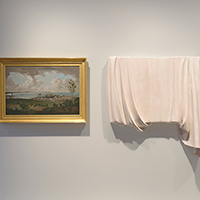
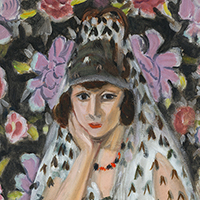
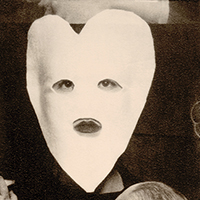
This notwithstanding, the National Portrait Gallery in Canberra, through the exhibition’s co-curators Dr Emma Kindred and Isobel Parker Philip, has brought the two artists together in an extensive display of over ninety works titled John Brack × Noel McKenna: A face in the mirror.
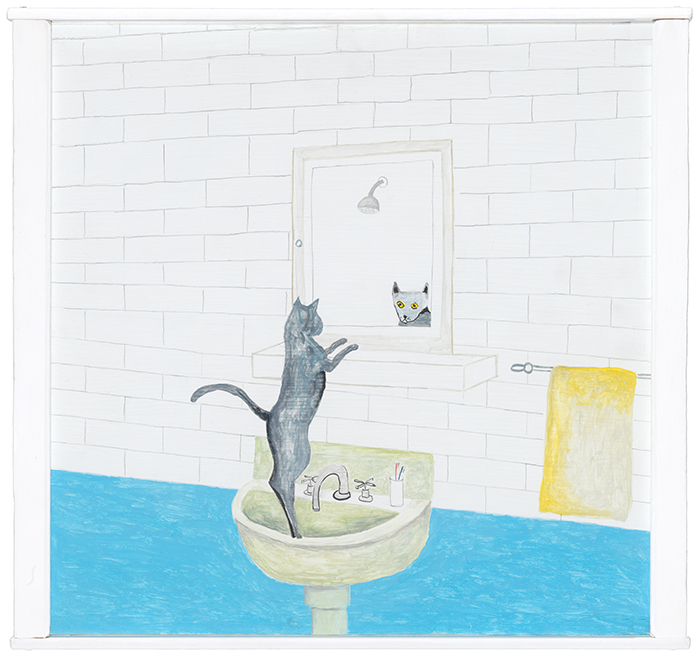
Noel McKenna, Cat at mirror / Private Collection / © Noel McKenna
As we are building a perspective on Australian art of the second half of the twentieth century, Brack is steadily emerging as the most significant Australian non-Indigenous figurative painter of his time. A cerebral master, who avoided passionate outbursts or romantic cries of despair, Brack over a career that spanned for a little more than four decades, produced a small but concentrated body of work that interrogated patterns of human behaviour. In his early work, the focus was on the immediate neighbourhood – his family, office workers rushing from their offices in the evening to catch their trams and trains, drinkers in a bar and people at the racetrack – to the later images that would serve as a more universal metaphor for the human condition.
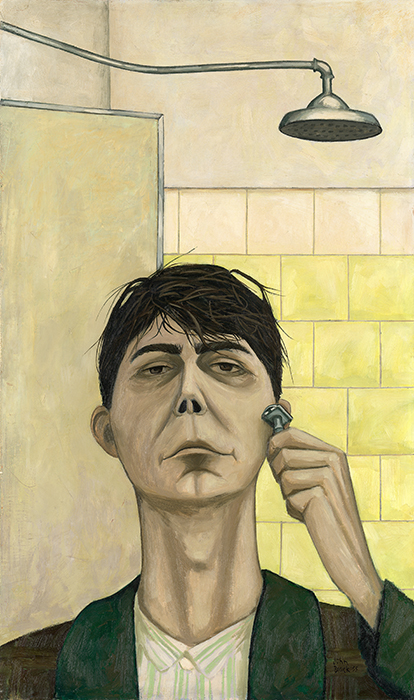
John Brack, Self-portrait, 1955 / National Gallery of Victoria, Melbourne / Purchased with the assistance of the National Gallery Women’s Association, 2000 / © Helen Brack
Despite Brack’s dedication to his art, he worked slowly and deliberately and would rarely complete more than about half-a-dozen paintings a year, most of which are held in major public collections. The beauty of this exhibition is the strong body of Brack’s paintings, particularly from the earlier years of his practice. This includes Brack’s iconic Self-portrait, 1955, where the artist shows himself shaving. He observed at the time, “shaving is the most obvious time to look at oneself in the mirror. Romantic, Byronic portraits of the artist are well enough, but haven’t we seen too many of them?” What we are observing is the mirror image, where all has been reversed and he appears in the painting as left-handed. Behind him the bathroom tiles, shower head, and shower door have been given a glowing acid yellow tone, that was to increase in intensity in his later works. What perhaps is the most disconcerting feature of this painting to the viewer is the exceptionally low viewpoint which has been adopted, an angle which would have been unnatural to a person shaving, and one which strikes a discordant note.
In this exhibition, the Brack Self-portrait is juxtaposed with Noel McKenna’s Cat at mirror, 2015. McKenna apparently appropriated his image from the internet but in the context of the exhibition the two ‘self-portraits’ make their ironic point. Throughout the show, we have these visual links, Brack’s Two typists, 1955, a study for a detail in the Collins Street, 5pm, 1955 painting, and McKenna’s Dr Joseph Brown with Two Typists, 1996, where the new owner of the Brack study is posed next to his precious possession.
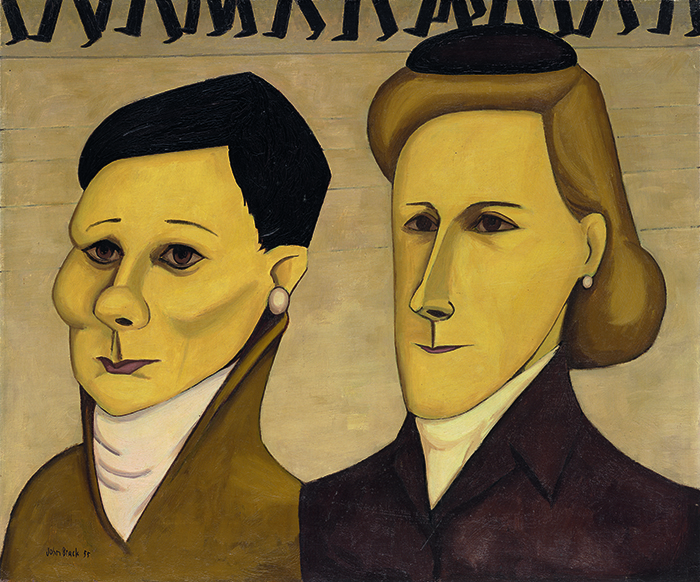
John Brack, Two typists, 1955 / National Gallery of Victoria, Melbourne / The Joseph Brown Collection. Presented through the NGV Foundation by Dr Joseph Brown AO OBE, Honorary Life Benefactor, 2004 / © Helen Brack
Major Brack masterworks, including The hands and faces, 1987 and Latin American Grand Final, 1969, form the backbone of the exhibition, while McKenna’s idiosyncratic anecdotal asides bring levity to the show.
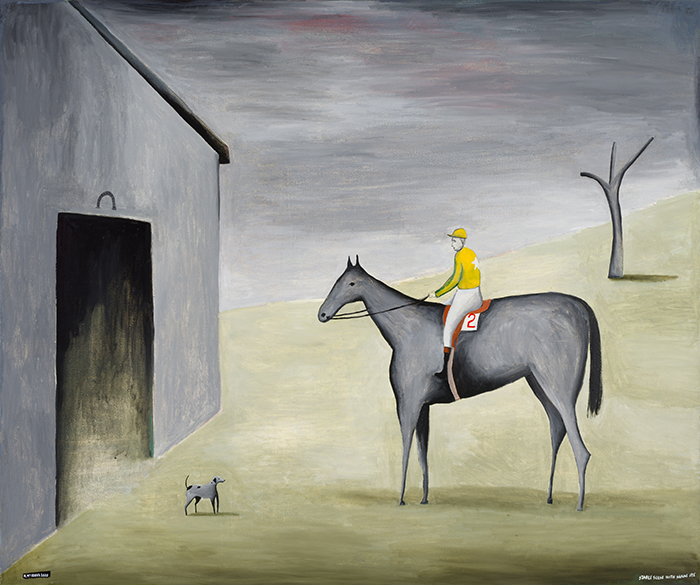
Noel McKenna, Stable Scene with Shane Dye, 2000 / Gift of the artist, 2019, donated through the Australian Government’s Cultural Gifts Program /
© Noel McKenna, Copyright Agency, 2026
Emeritus Professor Sasha Grishin AM, FAHA works nationally and internationally as an art historian, art critic, and curator.
National Portrait Gallery
3 April to 19 July 2026
Australian Capital Territory
Originally published in print – Art Almanac, June 2026 issue, pp. 23–26