Unlike Surrealist artists such as Rene Magritte, Yves Tanguy, and Salvador Dali, Kay Sage might not be famous, but she was one of the most prominent women artists associated with the Surrealism movement.
Sage was born in 1898 into a wealthy family in Albany, New York. As a child, she started painting and writing poetry and decided she wanted to be an artist. She travelled extensively with her mother and became proficient in several languages. When she was in her twenties she moved to Rome where she studied both landscape and figurative art. In Italy she married Prince Ranieri of San Faustino and then, for ten years, she rarely painted, until she decided to end her marriage and return to art. In 1937, Sage moved to Paris where she saw the work of the Surrealists. She was particularly impressed by the paintings of Giorgio de Chirico, and she met Yves Tanguy, whom she later married.
One of Sage’s paintings, Other answers, 1945, is a recent acquisition for the National Gallery of Victoria in Melbourne, and it is currently on display at NGV International. NGV Senior Curator, International Art, Ted Gott, says that Other answers is a classic, complex painting by Sage and exemplifies the essence of her Surrealist practice. “In Other answers a piece of cloth is caught in a swift wind, suspended across a taut wire. It flaps above a group of objects shrouded in a similar material, placed before a gently undulating landscape or sea vista. At left, wooden or steel scaffolding stands sparse and tall, casting ominous shadows across a foreground expanse of earth or sand. The sky is darkening, and the whole composition seems brooding, threatening, filled with unnerving and eerie potential.”
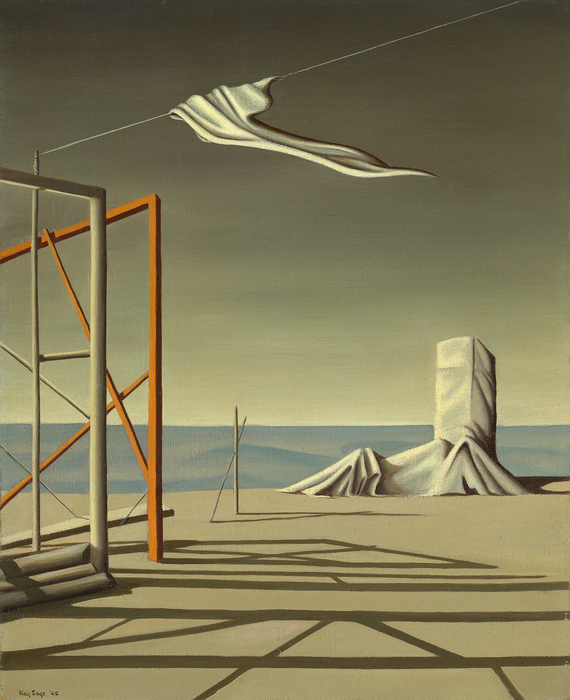
Kay Sage, Other answers, 1945, oil on canvas, 40.7 × 33.1cm
Collection National Gallery of Victoria, Melbourne. John William Fawcett Bequest, 2025
Courtesy NGV International, Melbourne
Gott says that Andre Breton, the founder of the Surrealist movement, “absolutely loathed” Sage. “Jealous of her influence over Tanguy, whom he regarded as one his proteges, he constantly denigrated her to the painter.” Sage remained magnanimous, however. She helped fund Breton and his family escape to New York following the Nazi occupation. Sage and Tanguy themselves also escaped.
In the United States, American critics, such as Alfred Frankenstein, were positive towards Sage’s enigmatic paintings and praised her ‘exceptional skill’. In 1941 Sage and Tanguy relocated from New York to the small town of Woodbury in Connecticut. Here the couple worked side by side in adjoining studios. “It was in Woodbury that Other answers was created in 1945,” Gott says. “In the same year the Art Institute of Chicago named Sage winner of the Watson F. Blair Purchase Prize, the first major public recognition of her emerging talent as an artist. Sage died in 1963 and following instructions in her will, the ashes of both her and Tanguy (who died in 1955) were scattered in the water off the coast of Tanguy’s native Brittany in 1964.
Bronwyn Watson has been writing about visual arts for leading newspapers and magazines for over thirty-five years.
NGV International
On display until at least February 2026
Melbourne
Originally published in print – Art Almanac, December 2025 / January 2026 issue, pp. 40–41