With a practice spanning more than six decades, Ken Unsworth could be considered the grandfather of conceptual art in Australia. Influenced by the Arte Povera movement of the 1960s, as well as earlier Surrealist and Dadaist movements, he is best known for sculptural installations integrating raw and industrial materials to create extraordinary abstract depictions of suspension and balance. The multidisciplinary artist also startled the art world in the 1970s with live performances using his own body and flesh in ritualistic works. Yet underpinning his art was a lesser-known drawing and painting practice.
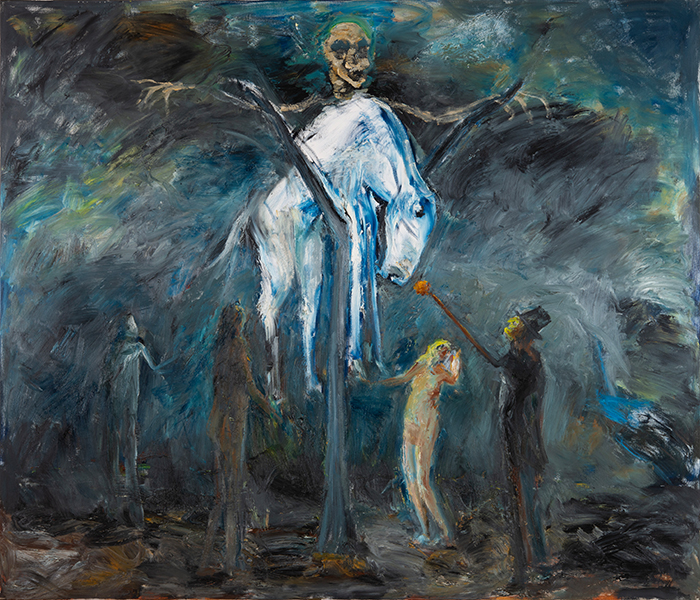
Ken Unsworth, Crucifixion (detail), 2019, oil on canvas, 184.5 × 221cm / Photograph: Effy Alexakis, Photowrite / Courtesy the artist and Macquarie University Art Gallery, Sydney
At ninety-five, this visionary artistic elder continues to create new work, and this exhibition will reveal his enduring passion for painting. Painting in the Dark presents paintings traversing his career from the 1950s to the present, in a collaboration between the artist and curators Rhonda Davis and Leonard Janiszewski of Macquarie University Art Gallery. Following last year’s Love is the Sweetest Thing (curated by Brad Buckley), Davis has committed to a trifecta of Unsworth exhibitions. So dedicated was the gallery to his work that it renovated its space in 2025 to accommodate some of his larger sculptures. This painting exhibition is the second in the series, followed by a drawing exhibition likely scheduled for 2028/9.
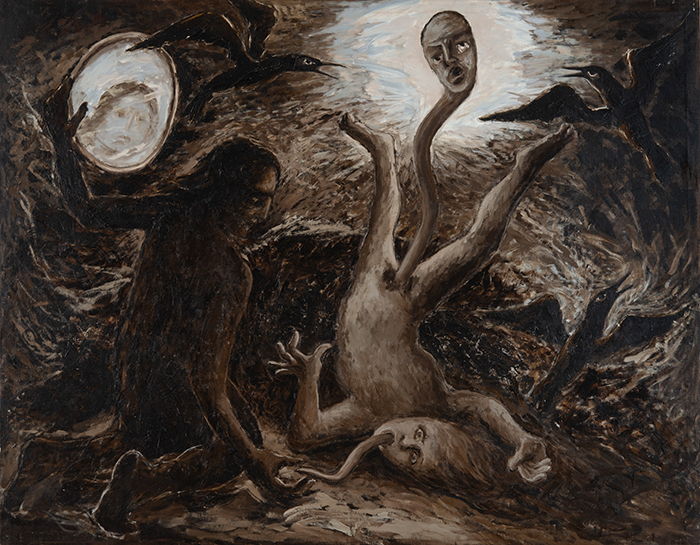
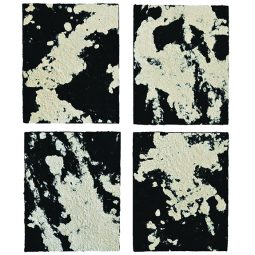
Ken Unsworth, Tainted Love, ‘The mirror and other fables’ series, 1984, bitumen, aluminium paint on canvas, 160 × 204cm / Courtesy the artist and Macquarie University Art Gallery, Sydney
“It’s been an incredible experience,” Rhonda Davis remarks. “I think it’s opening up new insights into his practice so that a lot of curators or scholars out there might reconsider going back and seeing how it all fitted in. With artists, there can be a missing piece to the puzzle and it’s just picking up those threads, because artists are often deeply complex. It’s a milestone exhibition for us.”
Davis and her team were introduced to Unsworth through writer and curator Paul McGillick in 2023 and visits to his home led to their first solo exhibition of his work.
“We were going to his house on occasions, and we couldn’t help but notice his painting. In his lounge room, he’s got his early paintings from the 1950s, where you see the inspiration from Arthur Boyd, in terms of the figure in the landscape
and mythology.
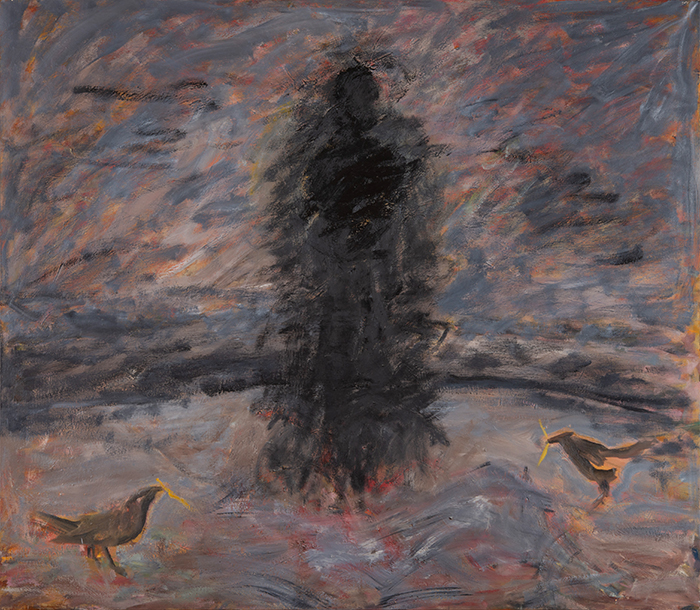
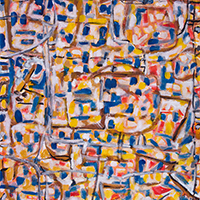
Ken Unsworth, Shadowland II, 2023, oil on canvas, 152 × 198cm / Courtesy the artist and Macquarie University Art Gallery, Sydney
“What’s amazing is that what we found in his installation and sculpture is also transferred into his painting; themes of the afterlife, death, and love.”
The exhibition’s title evokes both Unsworth’s brooding figurative landscapes and the unconscious momentum and flow of his painting practice. “I don’t set out to make a particular painting,” Unsworth comments in the exhibition catalogue. “It’s a journey. Each one is a new journey.”
The twenty-five paintings and three drawings span his seventy-year career, focusing on the 1980s and the past two decades. Most are large-scale works, including two triptychs and three paintings from this year.
Unsworth’s concerns with the afterlife and ritual thread through his oeuvre. His large-scale compositions are melancholic, often populated by ghoulish, spectral figures. Loose, gestural painting, executed with rags rather than brushes, evokes a dark wasteland.
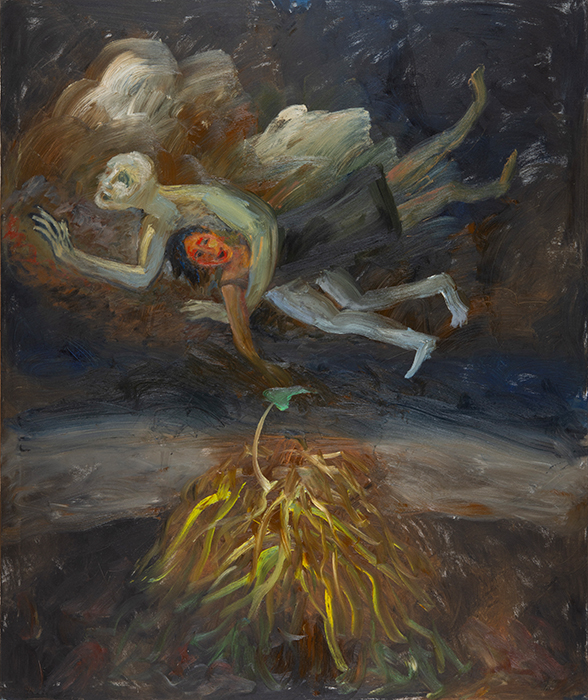
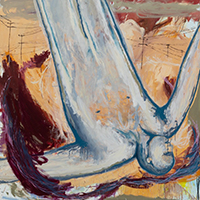
Ken Unsworth, Night Lily (middle panel of triptych) (detail), 2016, oil on canvas, 221 × 184.5cm (each panel); 221 × 553.5 cm (triptych) / Photograph: Effy Alexakis, Photowrite / Courtesy the artist and Macquarie University Art Gallery, Sydney
Davis describes the visceral ugliness and beauty embedded in his paintings. “In 1982, following a trip to Japan he became inspired by The Gaki scrolls in Japanese Buddhism. Some of the works from this period are very challenging and dark, but there’s a wonderful beauty in all of them. They’re very uplifting, full of energy. There’s that great sense of hope.”
She concludes that: “He has this very humble attitude. He does the work, and it’s out there, and you can make what you want of it. But still, he wants to have that legacy, and it’s an important legacy he’s given our nation. It’s also interesting in a sense how a small team can do as much as a big gallery for an artist.”
Victoria Hynes is a visual arts writer and editor based in Sydney.
Macquarie University Art Gallery
28 October 2026 to 17 February 2027
Sydney
Originally published in print – Art Almanac, November 2026 issue, pp. 22–27