“Little miracles in paint.”
A prolific artist for over five decades, Leonard Brown’s practice overlaps with his faith. Leonard Brown — Painting the Celestial delves into his history and the duality of his practice, from the minimal abstracts to the Byzantine traditional paintings and the iconographic conventions of the Russian Orthodox Church.
Born in Brisbane in 1949 and baptised in the Roman Catholic Church at birth, he suffered abuse at the hands of the Christian brothers at school. Painting the Celestial curator, Emeritus Professor Sasha Grishin AM, FAHA, shares that by 1969, he joined the Anglican Brookfield Friary as Brother Jeremy. “By 1975, he found his true calling in the Russian Orthodox Church and was baptised into the Church in 1976,” says Grishin. “For most of the next fifty years, he has led an idiorrhythmic monastic life. His faith lies at the foundation of his art practice.”
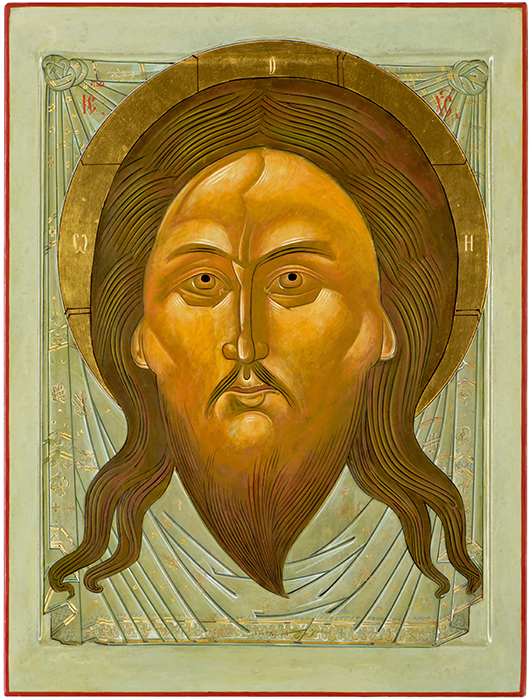
Through the hand of Leonard Brown, Holy Prophet and Forerunner of the Lord, John the Baptist, 2015, egg tempera on wooden panel, 61 × 46cm / Photograph: Mick Richards / Courtesy the artist and Ipswich Art Gallery, Queensland
Now in his mid-seventies, Painting the Celestial features almost one hundred works, spanning early pieces from art classes with Betty Churcher in 1963–4, followed by four years at the Central Technical College Art School, Brisbane, through to his current art practice. His winning works for the Blake Prize in 2010 and the inaugural Brisbane Portrait Prize in 2019 are also curated into the show. “The exhibition shows the consistency, depth and outstanding quality of his art practice – both in the sublime, minimal non-figurative paintings and in the painted icons of the church,” says Grishin.
Grishin first saw Brown’s paintings at Garry Anderson’s Sydney gallery in the 1980s, where the curator was drawn to their “subtle tonality and spiritual presence.” But it was during a visit to the Queensland Art Gallery in Brisbane where Grishin saw one of his drawings, leading to their first encounter. “I popped in to see him on the way to the airport,” the curator explains. “I was captivated by his presence and the beauty and range of his work. I missed my flight but made a friend.”
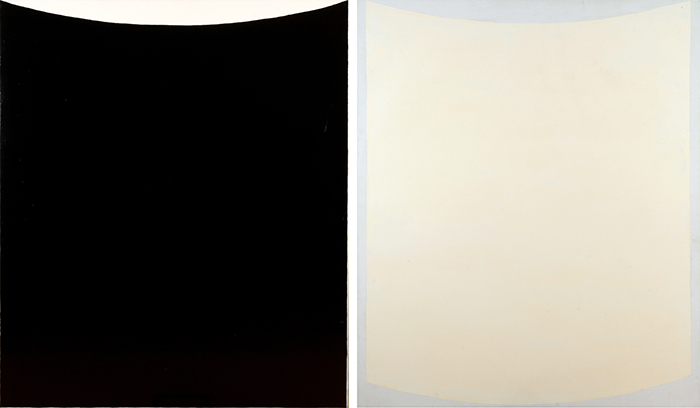
Black Mandylion, 1996, solver enamel on Belgian linen, 182.5 × 152.2cm / Photograph: Mick Richards / Courtesy the artist and Ipswich Art Gallery, Queensland
White Mandylion, 1996, solver enamel on Belgian linen, 182.5 × 152.2cm / Photograph: Mick Richards / Courtesy the artist and Ipswich Art Gallery, Queensland
With Brown now living in Ipswich, the Ipswich Art Gallery wanted to celebrate their local artist with a major retrospective, inviting Grishin to serve as guest curator. Working closely with the gallery and the artist, the exhibition explores ‘painting the celestial,’ which the curator shares is “a vision that unfolds in two related art forms.” Abstract oils on linen works like the cloud of unknowing, 2018 to the traditional icon paintings channelled through his hand, such as Holy Prophet and Forerunner of the Lord, John the Baptist, 2015, depicted in a medieval conventional method of egg tempera with rare and precious pigments on wooden panel, and real twenty-four-karat gold leaf.
“Going through this exhibition is like going through a spiritual shower, and the experience of the feeling of elation,” says Grishin. “It is a triumph of slow art – the works do have an immediate impact, they are objects of great beauty – however, if you linger with them a while, you will discover a slowly enveloping beauty and a solemn power. Little miracles in paint.”
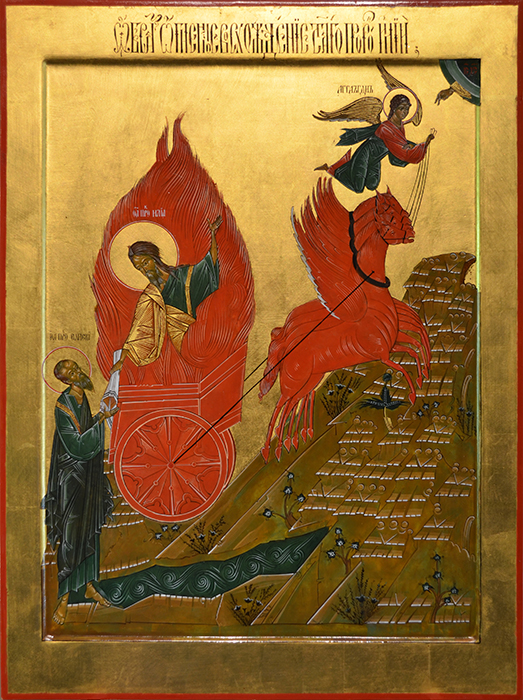
Through the hand of Leonard Brown, The ascent of the Holy Prophet Elijah passing his mantel to his disciple the Holy Prophet Elisah, 2014, egg tempera wooden panel, 61 × 46cm / Photograph: Leonard Brown / Courtesy the artist and Ipswich Art Gallery, Queensland
To invite a transcendental and elevated plane of being, the curator wanted to honour the paintings in a sacred space. “We have constructed a sanctuary-like space that, at considerable expense, has been painted gold, and the icons are exhibited within this space,” concludes Grishin. “I don’t think that this has ever been attempted in an Australian gallery before, and I am grateful to the Ipswich Art Gallery for trusting me with this very ambitious project.”
Emma-Kate Wilson is an art and design writer and editor based on Gumbaynggirr Country (Bellingen, New South Wales).
Ipswich Art Gallery
28 March to 14 June 2026
Queensland
Originally published in print – Art Almanac, April 2026 issue, pp. 18–21