Hany Armanious, who was born in Egypt in 1962, was six years old when he migrated to Sydney with his parents, his brothers, and sister. He has said that his first impression of Australia was “just how bright the light was, and it really was like stepping into another world.” Armanious explains that Cairo is predominantly grey and dusty with few trees or greenery, so for him what was most striking was the bright green of the Australian trees and the bright red of the terracotta roofs. Since then, Armanious, who is best known for his sculptural work with casting, has represented Australia at the Venice Biennale in 2011.
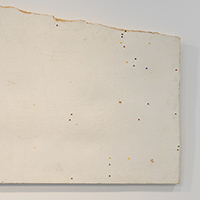
In 2024 Armanious held a major survey, Hany Armanious: Stone Soup, at the Henry Moore Institute in the UK. An expanded version of that exhibition, now featuring more than seventy works, is showing at Buxton Contemporary, The University of Melbourne. One of the works on display, Empathy Chart, from 2009, is in the collection of Sydney’s Museum of Contemporary Art Australia and is on loan to the exhibition. Empathy Chart, a replication of a discarded noticeboard, is “a kind of manifesto for Armanious’s approach to sculpture,” says Laurence Sillars, Head of the Henry Moore Institute and guest curator of Hany Armanious: Stone Soup.

Hany Armanious, Empathy Chart, 2009, cast polyurethane, pigment, 86 × 122 × 2cm
Collection Museum of Contemporary Art Australia. Purchased with funds donated by Andrew and Cathy Cameron, 2009
When Armanious found the original discarded noticeboard, he was struck by the rhythmic scatter of coloured pins that formed an unintentional abstract pattern. He then cast the noticeboard in resin, making sure to reproduce every detail, even the tiny flaws, Sillars says. “Empathy Chart encapsulates Armanious’s fascination with how meaning accumulates in the most everyday of objects and how that meaning can be gently undone. It’s a broken, chalky-white noticeboard, its surface scattered with coloured pinheads, but it becomes something far more than a piece of workplace detritus. Through the process of casting, he transforms it into a work that draws attention to unconscious acts of mark-making and decision-making: where to pin, which colour to choose, how to avoid repetition. In doing so, he elevates the accidental and overlooked into a site of contemplation. It’s a perfect example of how Armanious uses replication not to copy, but to see afresh.”
The title Empathy Chart adds a layer of quiet humour and poignancy, Sillars says. “It suggests a wellbeing diagram or emotional register, as if each coloured pin were charting our inner states. That combination of chance, precision, and wit is very characteristic of Armanious.”
When asked about his personal response to Empathy Chart, Sillars says he finds it “moving”. “There’s a tenderness, a romance even, in the way Armanious attends to the smallest traces of use – the pinholes, smudges, and mistakes – and in how he rescues something so ordinary from disappearance. It’s a work that
makes me slow down and really look, to consider how the simplest human gestures can carry beauty and significance. For me, it embodies the generosity of his practice: his belief that something of significance can emerge from anything if we’re willing to look closely enough.”
Bronwyn Watson has been writing about visual arts for leading newspapers and magazines for over thirty-five years.
Buxton Contemporary
On display in Hany Armanious: Stone Soup until 11 April 2026
Melbourne
Originally published in print – Art Almanac, March 2026 issue, pp. 30–31