When Marikit Santiago was in her last years of art school a lecturer told her not to base her art practice on autobiographical themes. After hearing this, Santiago has said she felt “totally and utterly dejected. If I couldn’t make work about the only thing I have complete and confident authority over, what else was I supposed to do?” She decided to ignore the advice and not change tack.
Since then, Santiago, who was born in 1985 in Melbourne, has won awards such as the Sir John Sulman Prize in 2020, and the La Prairie Art Award in 2024. She has been a finalist in the Archibald Prize several times and has been chosen for the Adelaide Biennial of Australian Art. Numerous works by Santiago are in the collection of the Art Gallery of New South Wales in Sydney and one of them, The Divine, from 2020, is on display in an exhibition, And Still I Rise.
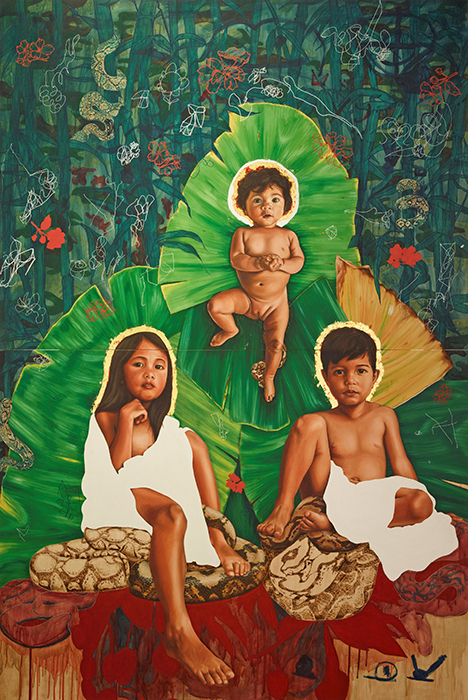
Marikit Santiago, The Divine, 2020, acrylic, oil, pen, pyrography and 18ct gold leaf on ply, 179.5 × 120.5 × 8cm / Art Gallery of New South Wales Collection / Donated through the Australian Government’s Cultural Gifts Program by Marikit Santiago, 2024
At the gallery, the exhibition’s curator and curator of Asian art, Natalie Seiz says that The Divine won the Sulman Prize in 2020, which marked the first time a woman of Filipina Australian ancestry was recognised for winning such a significant prize and it highlights the importance of cultural and artistic diversity in contemporary Australian art. “The work is a deeply personal painting that explores the many facets of Santiago’s identity as a Filipina, Australian woman, mother, and artist,” Seiz explains. “Along with this, she draws from Catholicism and the Western art historical canon to establish symbols and contexts relating to herself, her ancestry, and her family. The work portrays Santiago’s three young children, each depicted with golden halos, a symbol commonly used in Christian art alluding to ‘the divine,’ and spiritual status of the individual. Santiago credited the painting as a collaboration with her three children, Maella Santiago, Santi Mateo Santiago, and Sarita Santiago, who contributed pen and paint markings to the work. They are a very important part of her creative process.”
When looking at The Divine, Seiz says the painting carries an uncanny familiarity for her, having grown up surrounded by both Catholic and Russian iconography as a child. “My immediate response is that I am seeing a baby Jesus, however not the version I grew up with, featuring blue eyes and blond hair. Instead, this is a girl, has brown hair and skin and is surrounded by tropical palm leaves and Asian textile patterns. It is a child who looks more like me and my family. As such, the painting draws me in, into an Australian context that I recognise and in which I feel included.”
Bronwyn Watson has been writing about visual arts for leading newspapers and magazines for over thirty-five years.
Art Gallery of New South Wales
On display in And Still I Rise until 10 January 2027
Sydney
Originally published in print – Art Almanac, June 2026 issue, pp. 34–35