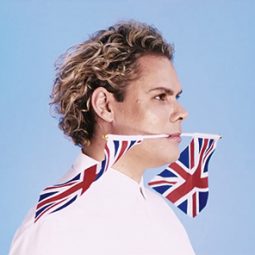
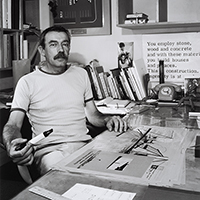
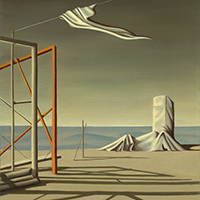
When Christian Thompson was a child, he travelled extensively with his family thanks to his father’s job in the Royal Australian Air Force. During holidays however the family would regularly return to Barcaldine in southwestern Queensland where Thompson’s father was born. “We always referred to it as home,” Thompson has said. “We spent weeks on end in the bush with my great aunts and cousins. We had a very traditional Aboriginal upbringing. I now realise how rare this is, and I am very thankful to my family for instilling in us such pride in our roots.” Since that time, much of Thompson’s work has been connected to memories of time spent in Barcaldine.
Thompson, who was born in 1978 in Gawler, South Australia, initially trained as a sculptor but his practice now includes photography, video, and performance. In 2010 he was one of two inaugural recipients of the Charles Perkins Scholarship, and he was admitted to the University of Oxford, England, where he completed his PhD in fine art at Trinity College. His work is well represented in major international and national collections. Numerous works by Thompson are also in the collection of the Newcastle Art Gallery in New South Wales, which recently underwent a major expansion project and reopened in February.
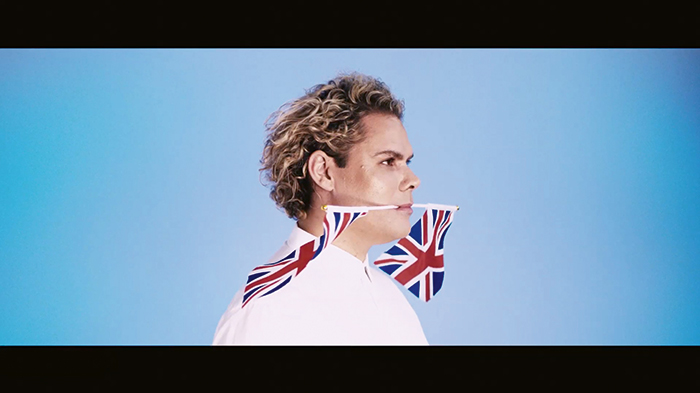
Christian Thompson, Dead Tongue, 2015, single channel video, sound, 3:32 minutes / Collection Newcastle Art Gallery, New South Wales. Donated through the Australian Government’s Cultural Gifts Program, 2021
One of Thompson’s video works in the Newcastle collection is Dead Tongue, and it is currently on display in an exhibition, Iconic Loved Unexpected, the gallery’s inaugural display of the collection. Dead Tongue was developed in 2015 when Thompson was chosen as one of twelve artists to be mentored by performance artist Marina Abramovic as part of the Kaldor Public Art Project. Dead Tongue features the artist singing in the Bidjara language of his people. Thompson has explained that Bidjara is officially an endangered language, but says his work is “motivated by the simple yet profound idea that if even one word of an endangered language is spoken it continues to be a living language.”
Newcastle Art Gallery director Lauretta Morton says that Dead Tongue was conceived in Sydney, produced in Oxford, and first exhibited in Melbourne when it was commissioned by the Koorie Heritage Trust for the artist’s solo exhibition in 2015. “It is a significant work of art in Dr Christian Thompson AO’s ongoing project to revitalise the Bidjara language,” Morton says. “When he recorded the sound and footage, he was undertaking his doctoral studies at the University of Oxford.”
Dead Tongue is a profound and elegantly simple response to the complex enduring effects of colonisation, Morton says. “Watching the video is a transcendent experience, equally haunting and sublime. It reminds us of the power of language and the importance of celebrating all sorts of knowing and being in the world. The artist’s surreal vocal performance in Dead Tongue belies the colonial claim that many First Nations cultures are either extinct or obsolete.”
Bronwyn Watson has been writing about visual arts for leading newspapers and magazines for over thirty-five years.
Newcastle Art Gallery
On display in Iconic Loved Unexpected, Newcastle Art Gallery’s inaugural long-term display of the permanent collection
New South Wales
Originally published in print – Art Almanac, May 2026 issue, pp. 36–37