Kirsten Coelho
Wendy Walker
Wakefield Press
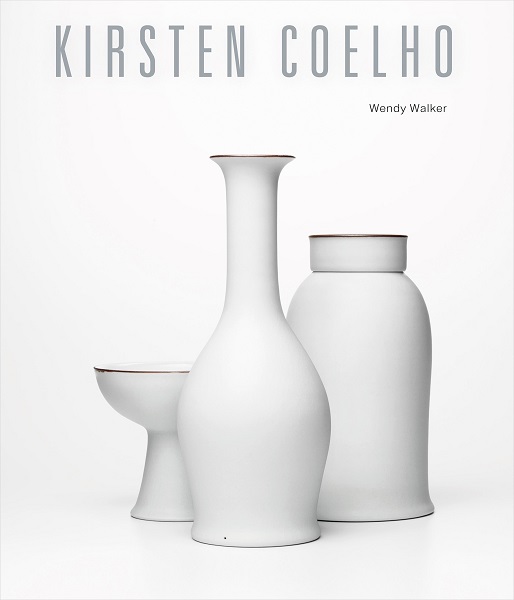
Comprehensive, engaging, and richly illustrated, this book celebrates the practice of Adelaide-based ceramicist, Kirsten Coelho. Working predominantly in high-fired porcelain, Coelho creates forms and vessels that oscillate between everyday function and ethereal beauty, reflecting her preferred fusion of the formal with the abstract. The stillness of her pared-back narrow-necked bottles, vases and bowls, cups and lidded jars fill the pages of this publication, woven with fragments of poetry and reproductions of paintings by Jean-Baptiste-Siméon Chardin, Russell Drysdale and Vilhelm Hammershøi, as well as photographs of the artist’s studio. Fellow artist Glenn Barkley provides a personal connection to Coelho’s work in the book’s foreword. Owner of two of her cups, he shows appreciation for Coelho’s refinement of the craft, stating, ‘Up close, you can observe the way the base touches the tabletop. It is solid and robust… and it’s never going to tip.’ He continues ‘You notice the slow curve into the base that could be glaze or could be a turned trick, the hypnotic eggshell-blue interior and the soft point of the rim as you sip. The cup never fails to be enjoyable to handle, and it’s through this kind of pragmatic, everyday use that Coelho’s works create an important connection – the loop between maker, user and object.’
.
In a series of essays that follow, Wendy Walker begins with an extension of this engagement with each object, before mapping out the evolution of Coelho’s textured practice, framed by art history, literature and cinema which has ‘driven a succession of formal shifts – a shaping of changes’ writes Walker. She continues, supporting Barkley’s theory, that ‘Coelho’s small universes of transcultural objects transcend the familiarity of their everyday contexts to enshrine narratives of migration, transition and resettlement.’ Walker also examines the artist’s choreographed installations; her rhythmic grouping of objects, material crossovers and, particularly, her preoccupation with the play of light and shadow. A prelude of Coelho’s artistic career spanning from 1990 to 2007 is included and supported by quotes by the artist and various other sources. The years 2007 to 2020 follow, focusing on education, studio practice, residencies, collaborations and specific exhibitions, as well as her developments and experimentations in ceramics and adoption of the ensemble format.
Fittingly, the book concludes with an essay on ‘Ithaca’, the ancient Greek island that was home to and symbolic end of Odysseus’ travels, and Coehlo’s own return to her roots. Her concept of home, abstracted by time and the inevitability of change, is suggestive of her own journey and ongoing exploration of this guiding medium.


