Melbourne Art Fair held an artist forum today as part of its Lecture and Forum Program. The panel comprised of four painters – Amber Wallis, Grant Nimmo, Julia Gorman, and Matthew Hopkins – each of whom work in vastly different manners: utilising the visual languages of abstraction, figuration and appropriation, as well as expanding painting to incorporate elements of collage, drawing, sculpture, installation art and spatial practices.
Each panel artist spoke of the work of another artist who has heavily influenced and impacted their own artistic practice:
Amber Wallis spoke on the American late-modernist painter Cy Twombly. Wallis spoke of the seeds of creativity and what started her painting. She spoke of viewing Twombly’s work, ‘3 Studies from the Temeraire’, at the Art Gallery of New South Wales for the first time affected her deeply. She gushed at how this was her favourite and spoke of her admiration for it: “I would live with this work, I would sleep with it”, she said. The physicality of the work, its unevenness provided a freedom to do what she wanted, that painting like this served no conformity. She described Twombly’s work as sensuous and physical with its hand-prints and harmonious lines. Wallis ‘loves’ Twombly’s lines – although thick, they are ‘gentle and effortless’ – and the influence of Twombly’s lines can be found in her work. Wallis went on to speak of how her work and art of painting in this stage of her life has become more important than theory – it is about you as an art maker and your experiences.
Wallis also spoke of Russian expressionist Wassily Kandinsky. Wallis spoke of her love for Kandinsky and his ‘Improvisations’, describing these works as opening the floodgates of possibility to be free within her own painting. Kandinsky created his work like an improvisation and this is what Wallis saw as inspiring. She concluded her talk by saying that when you find an artwork which is inspiring you are reminded of how off the path you can sometimes be in your own art practice. The beauty and simplicity of these works get you back on that path.

Amber Wallis, Utopian Slumps Gallery, Stand C39
Grant Nimmo spoke on the contemporary American painter Dana Schultz. He was fascinated with Schultz’s exhibition, ‘If The Face Had Wheels, a ten year retrospective. Nimmo likes the “brightness and meaningfulness” of her work, the “complacency and narrow-mindedness”. Nimmo particularly likes her character, Frank in her ‘fiction’ works. Nimmo goes on to state that it is as if she is portraying a parallel world to our own but with slightly different decisions made. The character of Frank is portrayed as the last man on earth – well, not entirely alone, Schultz is there to paint his picture. Nimmo describes Schultz’s works as a far cry from the contemporary works about climate change. Schultz creates this apocalyptic scenario as a daydream. Nimmo considers her use of subject matter with an evolving theme interesting – Frank would in later works ‘evolve’ with Schultz dismembering and rebuilding him. Nimmo loves how she opens up to her subjects and he too tries to approach his work with a topic in mind but with a broader theme. Her work reminds him that themes need to evolve to create the freedom you need to keep your work exciting.

Grant Nimmo, Anna Pappas Gallery, Stand F30
Julia Gorman spoke on the contemporary American sculptural and installation artist, Jessica Stockholder. Gorman, whilst completing an honours program at RMIT, was in search for “something more” in her art practice and she found it with several colourful rolls of tape. She planned to redesign the architecture of her canvas but soon found, in a book, the work of Jessica Stockholder. Stockholder’s work was exactly what Gorman wanted to create. Stockholder played with the thinness and thickness of colour and Gorman was fascinated with her encompassing and detailed installations. She loved how Stockholder used what she found and the space she created with these objects. Gorman did admit that she has not yet seen a work by Stockholder in real life, her admiration and study of her work has been entirely based on images in books. She was initially disappointed that there was an existing artist which produced works in the style she had herself hoped to create. She had looked at Stockholder’s work from the late-80s to mid-90s and was “put out” by the fact that it was all there. She felt like there was no space for her in this style of art making. That is until she saw the work ‘spICE BOXed project(ion)’ which the artist did not particularly like because the colour did not project the way she wanted, it was flat according to Stockholder. But Gorman loved the colour green and thought she could use it to detach herself from Stockholder’s dominance in this art style. Gorman concluded her talk by stating that, overall, Stockholder’s playfulness and lightheartedness in using colour to pull together different geometric objects is what inspired her in her art practice.

Julia Gorman, Arc One Gallery, Stand E12
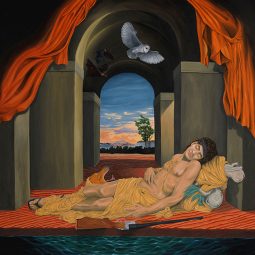
Matthew Hopkins spoke about the American artist Jim Shaw, specifically his ‘Dream Drawing’s series. Shaw explored dark recesses of American subconscious at large and his ‘Dream Drawing’ series is one of Hopkins’ favourites. He likes the way Shaw treated the dream and this is what has influenced his work. Shaw has deviated from the idealised devotion that the Surrealist created. He treats dreams as an exhausting and mechanised process – recording his own dreams first in pencil before laying out the image in his paintings and/or video and sound installations. Hopkins liked that Shaw’s drawings were bland and storyboard-like. He went on to state that in his blandness Shaw has achieved what Surrealists only tried to do, a new heightened reality with dreams. Hopkins’ own work is about waking dreams and, influenced by Shaw’s treatment of dreams and their representation, produces bland and exhausting images.