Connection to country is an incredibly powerful concept in the context of Indigenous culture – and while most Australians think that we understand what it means, the complexities of Aboriginal relationships to their land is often underestimated and misunderstood. ‘My Country, I Still Call Australia Home: Contemporary Art from Black Australia’ helps begin to change that. The exhibition aims to address “things that people may have thought they knew, but to look at them through a different pair of eyes”, says Curator Bruce McLean.
Presented at Brisbane’s Gallery of Modern Art (GOMA), the exhibition is an important showcase of work by contemporary Indigenous Australian artists. As McLean describes, “I think the work is really asking people to open themselves up and to consider what they – or what these issues more generally – would feel like. What if they were in that position? It’s about a universal call for empathy.”
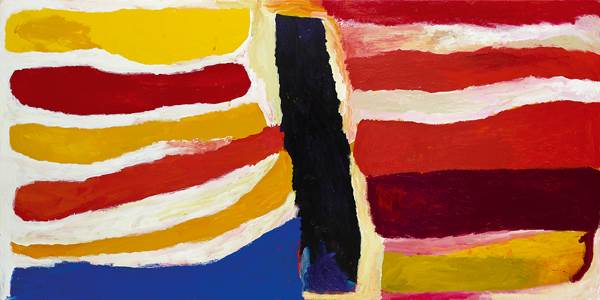
As McLean explains, connection to country is an idea that everyone relates to very strongly. The core of the exhibition is the ancient history that connects Aboriginal and Torres Strait Islander people to their land, and just as importantly, responses to the dislocation of people from their country and how this history affects their lives today.
Including works from more traditional painting techniques to the forefront of digital technology, the exhibition links the present day to the past, both historically and artistically. The symbiosis between old and new emphasises the politics and policies that reverberate a continued tension through our culture.
Cory Surprise and Sally Gabori, whose paintings tell their respective Dreamtime stories, are presented along side the urban street art of Reko Rennie, contemporary photography by Bindi Cole, and the gallery’s first 3D video work by Warwick Thornton.
Where Vincent Serico’s work tells the history of the lead up to the Hornet Bank Massacre in 1857 as passed down through his family links, Vernon Ah Kee’s confronting video installation Tall Man, 2010, documents first hand the Palm Island riots in 2004, and is a jolting reminder that this turbulent relationship between Aboriginal people and the police is still resulting in conflict and tragedy today.

Through the work of more than 25 artists from remote communities across Australia, we gain an insight into the intangible connections Indigenous people hold with the landscape: paintings evoke currents of energy in the air or water, the power of sacred and ceremonial sites, story-telling through generations and unseen, spiritual forces that resonate through the topography of the land. Giving a different perspective to mapping, Megan Cope re-inserts missing Aboriginal place names on vintage military survey maps to create a presence for the Aboriginal heritage that lies underneath Brisbane’s now highly urbanised areas.
‘My Country, I Still Call Australia Home’ challenges us to look at Australian history through an Aboriginal perspective. The consequence of such a challenge makes us re-consider what we know and who we are. It shows that Indigenous art belongs at the forefront of Australia’s contemporary art scene, and that the dialogue that these works open is crucial to Australian culture today.
Queensland Art Gallery
Gallery of Modern Art (GOMA)
Until 7 October, 2013
Brisbane
Wakartu Cory Surprise, Mimpi, 2011, synthetic polymer paint on canvas
Bindi Cole, Frederina, 2009, pigment print on Hahnemühle Photo Rag paper
Courtesy the Queensland Art Gallery, Brisbane


