In 1973 the ‘Biennale of Sydney’ was a bellwether, one of the first in a now-packed calendar of international biennales. Currently in its 45th year of operation, it must continue to grapple with the substantial task of representing international and Australian contemporary art practice, while speaking persuasively to diverse audiences. This edition’s Artistic Director Mami Kataoka, Chief Curator of Tokyo’s Mori Art Museum since 2009, has delivered an exhibition that serves this need, turning these sometimes-conflicting requirements into a strength. Presenting the work of 70 artists and collectives across seven venues, the show seeks balance between the local and the global, and between official histories and individual memory.
While the overarching theme of ‘superposition’ – a term from quantum mechanics referring to the paradoxical duality of microscopic particles in motion – may at first glance seem overly complex, it doesn’t weigh the exhibition down with jargon. Kataoka deploys the concept with a light touch. She grants numerous entry points to the casual and scholarly viewer alike, offering vast experiences from the subtle to the bombastic. The presentation explores the multiplicity and interconnectedness of the human condition, replete with conflict, community and resilience. In an anniversary year, it also takes multiple opportunities for historical reflection and revision.

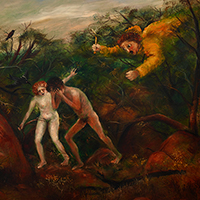
Marlene Gilson, What If, 2017, acrylic on linen, 120 x 150cm. Collection of David Atkins. Courtesy the artist
This reflective turn is most apparent at the Art Gallery of New South Wales (AGNSW), where a display of the Biennale’s archive of correspondence and media clippings gives insight into its early years. A suite of closely detailed figurative paintings by Wathaurung elder Marlene Gilson proffer a powerful revision to colonial narratives, reinstating Indigenous perspectives into events such as Captain Cook’s landing and the Eureka Stockade. Kataoka’s inclusion of works from the AGNSW collection by Roy de Maistre and Sydney Ball provide a historical context for Sixteen Conversations on Abstraction (2016), a project by Dutch artist Riet Wijnen that complicates the notion of artistic lineage with fictional ‘conversations’ between artists, presented as abstract diagrammatic sculpture. Kataoka’s interest in scientific and artistic process is also evident in the selection of works by Semiconductor, Samson Young and Rika Noguchi.

Brook Andrew, What’s Left Behind, 2018, installation view 2018 at the Museum of Contemporary Art Australia for the 21st Biennale of Sydney, mixed-media installation, dimensions variable. Contributing artists: Rushdi Anwar, Shiraz Bayjoo, Mayun Kiki, and Vered Snear. Courtesy the artist, Tolarno Galleries, Melbourne, Roslyn Oxley9 Gallery, Sydney and Galerie Nathalie Obadia, Paris and Brussels
Kataoka’s curatorial premise also draws on the ancient Chinese philosophy of Wuxing, in which everything is composed of the elements of wood, fire, earth, metal and water. The symbiosis and conflict of these components is represented through a number of works that emphasise the value of collaborative labour and collective narrative. Ciara Phillips’ project Workshop (2010-ongoing) transforms the ground floor gallery of the Museum of Contemporary Art Australia into a working print studio, melding together the sites of production and presentation. Drawing on the activist history of printmaking, Phillips will invite various Sydney community groups into the space to collaborate on new works. Marc Bauer’s installation of ceramics and drawings also blends collective and individual histories, visualising interviews the artist made with women in male-dominated workplaces in Brittany, France. Brook Andrew’s installation What’s Left Behind (2018) is the most direct reflection of Wuxing, comprising five sculptural vitrines representing the five elements. Andrew invited four contributing artists – Rushdi Anwar, Shiraz Bayjoo, Mayun Kiki and Vered Snear – to select artworks and archival objects from the collection of the Museum of Applied Arts and Sciences to be displayed within the cabinets. The effect of this overwriting of authorship and reframing of historical artefacts is a compelling palimpsest that prompts the viewer to consider the contested site between individual memory and official history.

Mit Jai Inn, Planes (Hover, Erupt, Erode), 2018, installation view 2018 at Cockatoo Island for the ’21st Biennale of Sydney’, mixed media installation with paintings. Commissioned by the Biennale of Sydney. Presentation at the 21st Biennale of Sydney was made possible with generous support from the Neilson Foundation. Photograph: Document Photography. Courtesy the artist and SA SA BASSAC, Phnom Penh
The blockbuster drawcard of the Biennale is Ai Weiwei’s Law of the Journey (2017), an oversized inflatable raft crowded with figures that creates an imposing presence in Cockatoo Island’s Turbine Hall. While spatially and politically impactful, nearby works by Abraham Cruzvillegas and Mit Jai Inn are better integrated into the site. Jai Inn worked onsite to produce his work Planes (Hover, Erupt, Erode) (2018), a series of paintings suspended from the rafters like ambiguous banners, their densely worked surfaces evoking the aged, industrial textures of their location. Cruzvillegas’ hanging sculptures are chaotic yet composed, incarnating the varied past lives of the found materials from which they are made. These installations, composed by a laborious process of accretion, speak not only to the specificity of the artists’ contexts but offer a representation of Kataoka’s vision of conflicting forces in productive and evolving equilibrium. Like many of the works in this year’s Biennale, they suggest a process of revision and reflection, unmaking and remaking.
Eleanor Zeichner is a writer from Sydney and current Assistant Curator at UTS Gallery.
Art Gallery of New South Wales, Artspace, Carriageworks, Cockatoo Island, Museum of Contemporary Art Australia, Sydney Opera House and 4A Centre for Contemporary Asian Art
Until 11 June, 2018
Sydney