“. . . vivid colours and familiar tactility inviting touch . . .”
Mechelle Bounpraseuth is known for her ceramic sculptures of food and household objects, rendered in bright, glossy colours and playful scales – gigantic lychees that reach halfway up a supersized sriracha bottle, oversized bowls of persimmons, and colossal can stacks. Fruits, especially those from her parent’s homeland of Laos, hold particular significance in Bounpraseuth’s practice as symbols of value, culture, and family tradition.
Bounpraseuth has always drawn on childhood memories in her practice, but intergenerational legacies have taken on particular significance since the birth of her daughter and the passing of her own mother. Comprised of four newly commissioned installations, ສູ້ສູ້ Sou Sou has given her a platform to extend these themes into an exhibition for children for the first time.
The centrepiece of the exhibition, ຂໍໃຫ້ເງິນຄຳໄຫລມາເທມາບໍ່ໃຫ້ຂາດ (Please, may money and gold flow and pour eternally without end), 2026, is a multi-tiered altar, adorned with a smorgasbord of fruits. Children and adults alike are invited to make their own offering on the altar in the form of fruits crafted from paper. Asking children to make an offering of their own is not a practice of replicating Bounpraseuth’s work but reflects a desire to meaningfully engage children with the themes of Bounpraseuth’s practice, such as labour, grief, and notions of value.
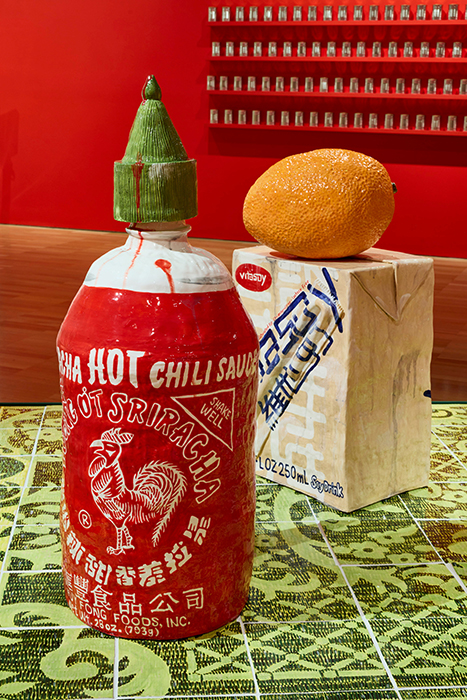
Installation view of ມາມາມາ Ma ma ma (Come come come) (detail), 2026, glazed tile and glazed earthenware, dimensions variable, in the Mechelle Bounpraseuth: ສູ້ສູ້ Sou Sou exhibition at the Art Gallery of New South Wales / Artworks © the artist / Photograph:
© Art Gallery of New South Wales, Mim Stirling
“I think people underestimate children,” says Bounpraseuth. “My approach is shaped as much by being a parent as it is by being an artist. I think about my daughter often, how intelligent and insightful she is. When I spoke with Emily [Sullivan, curator], we were aligned in what the exhibition could hold. It was important to me not to shy away from
these experiences but to engage children in ways they can genuinely understand.”
Another installation, ຮອດບ້ານແລ້ວ Hot baan Laeo (We’ve arrived home), 2026, invites visitors to sit within a blue hut, furnished with ສາດ saat (Lao floor mats). At intervals, the sounds of Laos play – a rooster crows, rain falls, an aunt gives a blessing in Lao. A lullaby dedicated to the Lao national flower, the frangipani, is sung in the voice of Bounpraseuth’s mother, herself, and her young daughter. The song is symbolic of the cultural inheritance that Bounpraseuth wants to offer her child, and the role of children in the continuation of culture.
In anecdotes from galleries that Bounpraseuth has exhibited with in the past, she learned that her work is particularly popular among children, their vivid colours and familiar tactility inviting touch, which usually isn’t allowed in gallery spaces. For this exhibition, Bounpraseuth wanted to create opportunities for touch. “Children are curious. I don’t want their first encounter with my work to be met with a ‘no,’” she says.
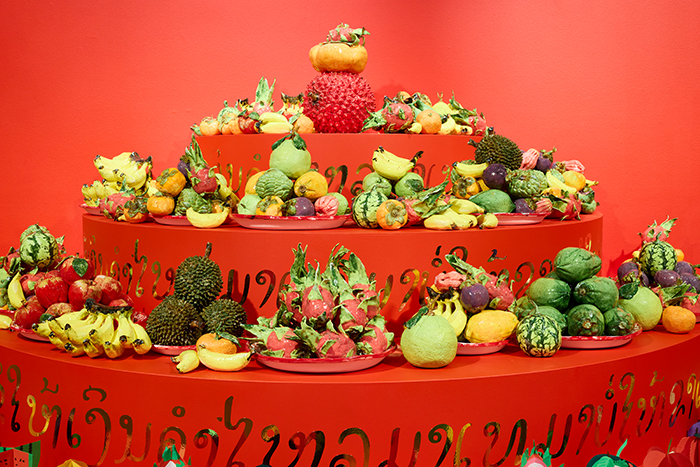
Installation view of ຂໍໃຫ້ເງິນຄຳໄຫລມາເທມາບໍ່ໃຫ້ຂາດ (Please, may money and gold flow and pour eternally without end) (detail), 2026, glazed earthenware, dimensions variable, in the Mechelle Bounpraseuth: ສູ້ສູ້ Sou Sou exhibition at the Art Gallery of New South Wales / Artworks © the artist / Photograph: © Art Gallery of New South Wales, Mim Stirling
Bounpraseuth recalls moments when she was told no in her own life – growing up within a church that stifled any form of questioning, or a lecturer who doubted her ability to work at scale on account of her physical size and gender. The exhibition title, ສູ້ສູ້ Sou Sou, is about finding the yes – a Lao phrase of encouragement that translates to ‘you can do it!’
“That’s the running theme of the exhibition, but also my life,” says Bounpraseuth. “I inherited all those things, the ability to see the beauty and value in things, to see a way through because of what my parents and my ancestors experienced. ສູ້ສູ້ Sou Sou is a term that connects me to that hardship, but also to that inheritance of perseverance, resilience, and resistance.”
Sophia Halloway is an art critic and writer based in Kamberri Canberra.
Art Gallery of New South Wales
14 March 2026 to February 2027
Sydney
Originally published in print – Art Almanac, May 2026 issue, pp. 24–28